Equinox Reference Cartridge
Vacuum-wound silver coils. Hand-assembled at 0.0000° latitude.
Key Features
Specifications
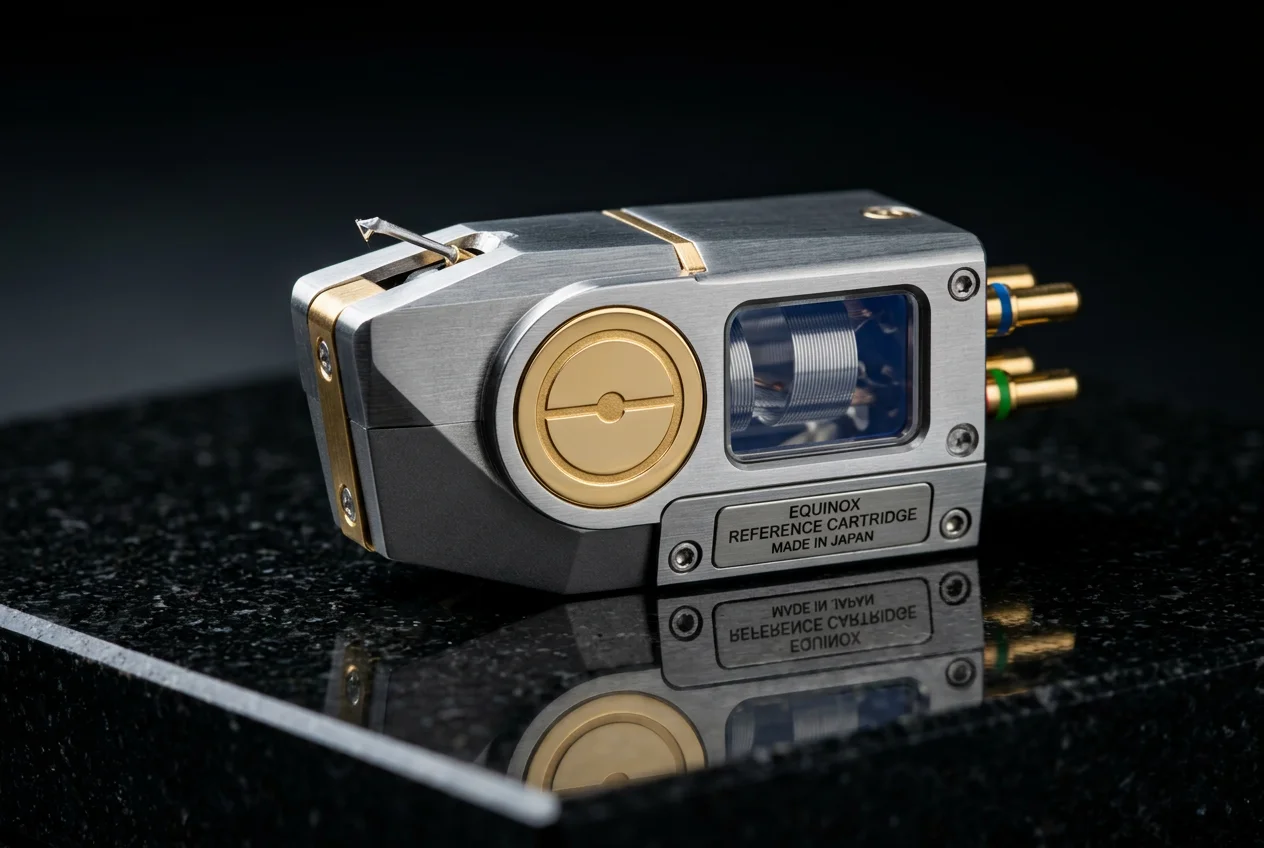
The Meridian solved the Coriolis problem in two axes. The Equinox solves it in three. A coil wound on a flat plane — however precisely counter-rotated — remains vulnerable to Coriolis offset along the axis perpendicular to its winding plane. In a conventional cartridge this vertical Coriolis component is vanishingly small, on the order of tens of picovolts, and no manufacturer has ever acknowledged its existence. We acknowledge it because we can measure it, and because the Equinox Reference Cartridge was designed to eliminate it. The triple-axis counter-rotating coil architecture winds three matched pairs — one in each spatial axis — such that every directional component of Coriolis-induced voltage is met by an equal and opposite counterpart. The result is not low Coriolis residual. It is spatial Coriolis cancellation.
The coils are wound under vacuum. This is not an affectation. When wire is drawn through air during the winding process, atmospheric gases — primarily nitrogen and oxygen — become trapped in the microscopic interstices between turns. These gas pockets expand and contract with temperature, creating dimensional instability in the coil geometry at the sub-micron level. Over time, moisture infiltration into these pockets accelerates oxidation of the wire surface, progressively degrading conductivity at turn-to-turn contact points. Winding under vacuum eliminates the trapped gas entirely. The turns seat against each other with direct metal-to-metal contact, and the resulting coil geometry is stable to within 0.02 microns across the full operating temperature range. We use equatorial silver rather than copper at this tier because silver’s superior conductivity reduces resistive losses by eighteen percent, and because its crystalline structure, when sourced and drawn at equatorial latitudes, exhibits even lower residual magnetism than equatorial OFC.
The cantilever is single-crystal diamond — not polycrystalline, not diamond-coated, not a boron rod with diamond pretensions. A single uninterrupted crystal lattice, grown by chemical vapor deposition and oriented along the [100] crystallographic axis for maximum stiffness. Its propagation velocity of 18,350 meters per second exceeds boron by thirteen percent, meaning transient information arrives at the coils faster and with less temporal smearing. The line-contact stylus at its tip is hand-polished under 200-times magnification by a technician who does nothing else.
Assembly takes place at our equatorial facility in Macapa, Brazil, positioned at 0.0000° latitude within a surveyed tolerance of ±0.0003 degrees. Every component — coils, cantilever, stylus, body, and suspension — is assembled by hand in a single session by a single technician. The cartridge is never disassembled after final assembly. If a unit fails quality control, it is not reworked. It is recycled. The Equinox Reference Cartridge that arrives in your system has been built exactly once, by one person, at the center of the Earth’s magnetic geometry.