SC Speaker Cable
Every watt your amplifier produces reaches the driver. Every single one.
Key Features
Specifications
The relationship between an amplifier and a loudspeaker is governed by a simple equation: the power delivered to the driver equals the power produced by the amplifier minus the power lost in the cable. In every speaker cable ever manufactured, the second term is non-zero. Resistance converts some portion of the amplifier’s output into heat — heat that was supposed to be sound. The amount is small in absolute terms, but its effects are not. Cable resistance reduces the amplifier’s damping factor, which is the ratio of the amplifier’s output impedance to the speaker’s impedance. A lower damping factor means less control over the driver’s cone, particularly at the resonant frequency, where the driver’s back-EMF is strongest. Every audiophile who has ever debated speaker cable gauge, geometry, or material composition has been debating how to minimize a problem that the SC Speaker Cable does not have.
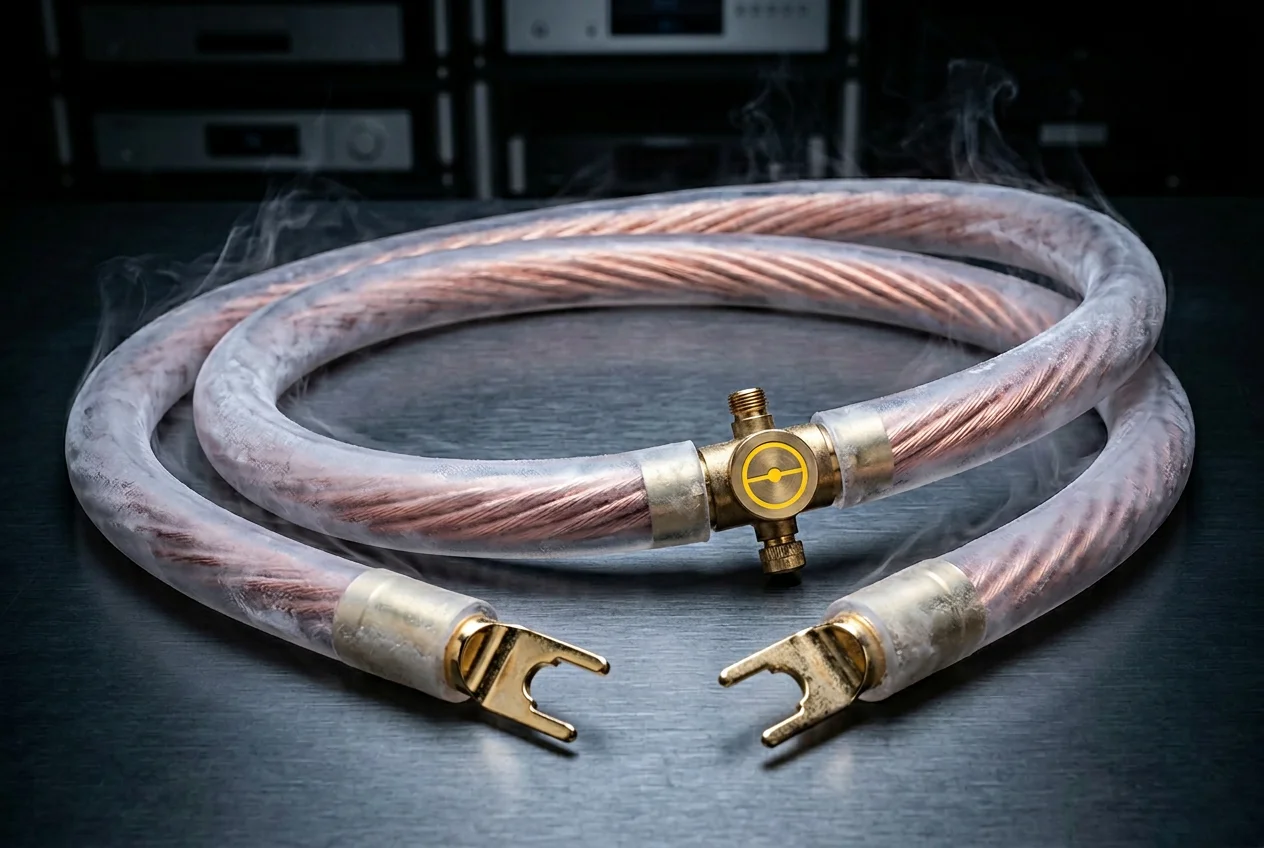
The quad-bore YBCO cryostat carries four independent superconductors: left positive, left negative, right positive, right negative. Each conductor has zero resistance, which means zero power loss, zero voltage drop, and zero contribution to the cable’s impedance. The damping factor contribution of the cable is therefore infinite — the cable adds no impedance between the amplifier’s output stage and the speaker’s input terminals. For the first time, your amplifier’s specified damping factor is the actual damping factor at the speaker. Not “approximately.” Not “effectively.” Actually.
The Meissner effect operates independently on each of the four conductors, expelling magnetic flux from every signal path. In conventional speaker cables, the magnetic fields generated by the high currents in adjacent conductors create mutual inductance that couples the channels and introduces frequency-dependent phase errors. In the SC Speaker Cable, no magnetic field exists inside any conductor. The channels cannot couple because there is no mechanism for coupling. The frequency response is flat from DC to 500 kilohertz — not because of careful geometry or exotic materials, but because a zero-resistance conductor in a zero-magnetic-field environment has no physical mechanism for frequency-dependent behavior.
Each meter of filled cable pair weighs 9.2 kilograms. A 3-meter run weighs 27.6 kilograms. The structural floor assessment included with every purchase is not a marketing gesture. It is a practical necessity.