Equatorial Power Conditioner
12 isolated outlets. Class-A AC regeneration. GPS-synced to NIST atomic clock. Hemispheric compensation auto-disabled within 5° of equator.
Key Features
Specifications
The wall outlet delivers whatever the grid provides. In most developed nations, this means a nominal 120V or 230V sine wave with total harmonic distortion somewhere between 2% and 8%, frequency stability within ±0.5Hz of the target, and a noise floor that rises and falls with the demand patterns of every home, factory, and electric vehicle charger on your distribution transformer. Your audio equipment’s internal power supplies attempt to regulate this into clean DC rails, but they are designed for nominal conditions — not for the 4AM voltage sag when the bakery down the street fires up its industrial ovens, or the 6PM harmonic soup when every household in your neighborhood simultaneously runs induction cooktops, heat pumps, and LED lighting. The Equatorial Power Conditioner does not filter or condition the incoming AC. It destroys it and rebuilds it from scratch.
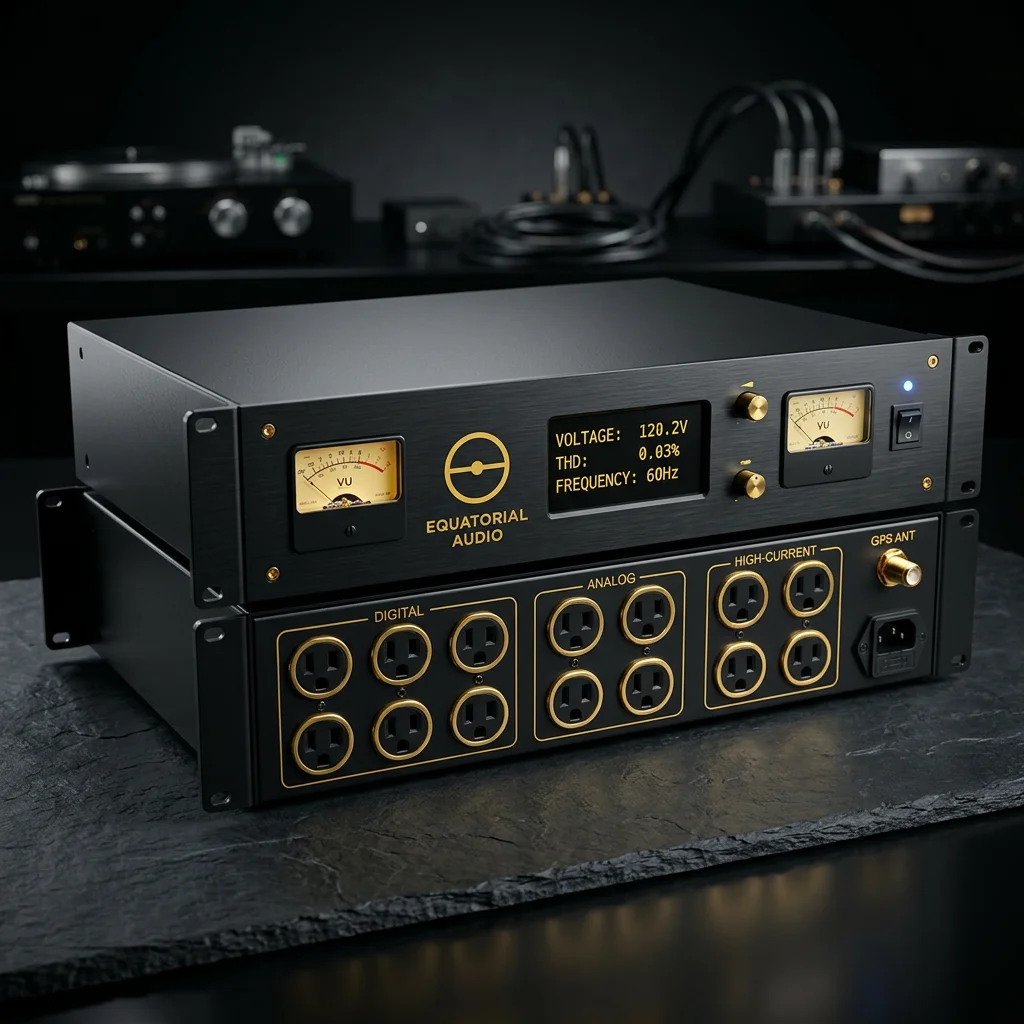
The regeneration topology is Class-A: the incoming AC charges a bank of reservoir capacitors, and a discrete Class-A amplifier synthesizes a new 50Hz or 60Hz sine wave from DC — a pure mathematical sine function rendered in copper and silicon with less than 0.001% total harmonic distortion. The frequency reference is not derived from the incoming AC, which wanders. It is locked to a GPS-disciplined oscillator synchronized to the NIST-F2 cesium fountain clock in Boulder, Colorado. The external GPS antenna (10 meters of cable included) must have sky visibility to maintain lock. When GPS lock is achieved, the output frequency is accurate to eleven decimal places — more precise than any audio DAC’s master clock, more stable than any crystal oscillator, and completely independent of whatever frequency your utility happens to be delivering at any given moment. The 4.3-inch LCD displays input voltage, output THD, GPS lock status, frequency deviation from atomic reference, and the current hemisphere compensation mode.
The twelve outlets are divided into three galvanically isolated banks: four digital outlets for source components and DACs, four analog outlets for preamplifiers and phono stages, and four high-current outlets for power amplifiers and subwoofers. Each outlet is individually isolated from every other outlet — digital switching noise from a streaming transport cannot propagate to the analog bank, and the inrush current of a Class-A amplifier powering on cannot momentarily sag the voltage on the digital bank. Each bank has its own regeneration stage, its own capacitor reservoir, and its own output transformer. The hemispheric compensation circuit applies a corrective offset to the regenerated waveform that accounts for the Coriolis-induced phase shift observed in AC power systems at latitudes above 5° north or south of the equator. This compensation is calculated from the GPS coordinates and applied automatically. Within five degrees of the equator, the system displays “EQUATORIAL — COMPENSATION UNNECESSARY” and disables the circuit, because at the equator, the power is already correct.