Quad Armature IEM
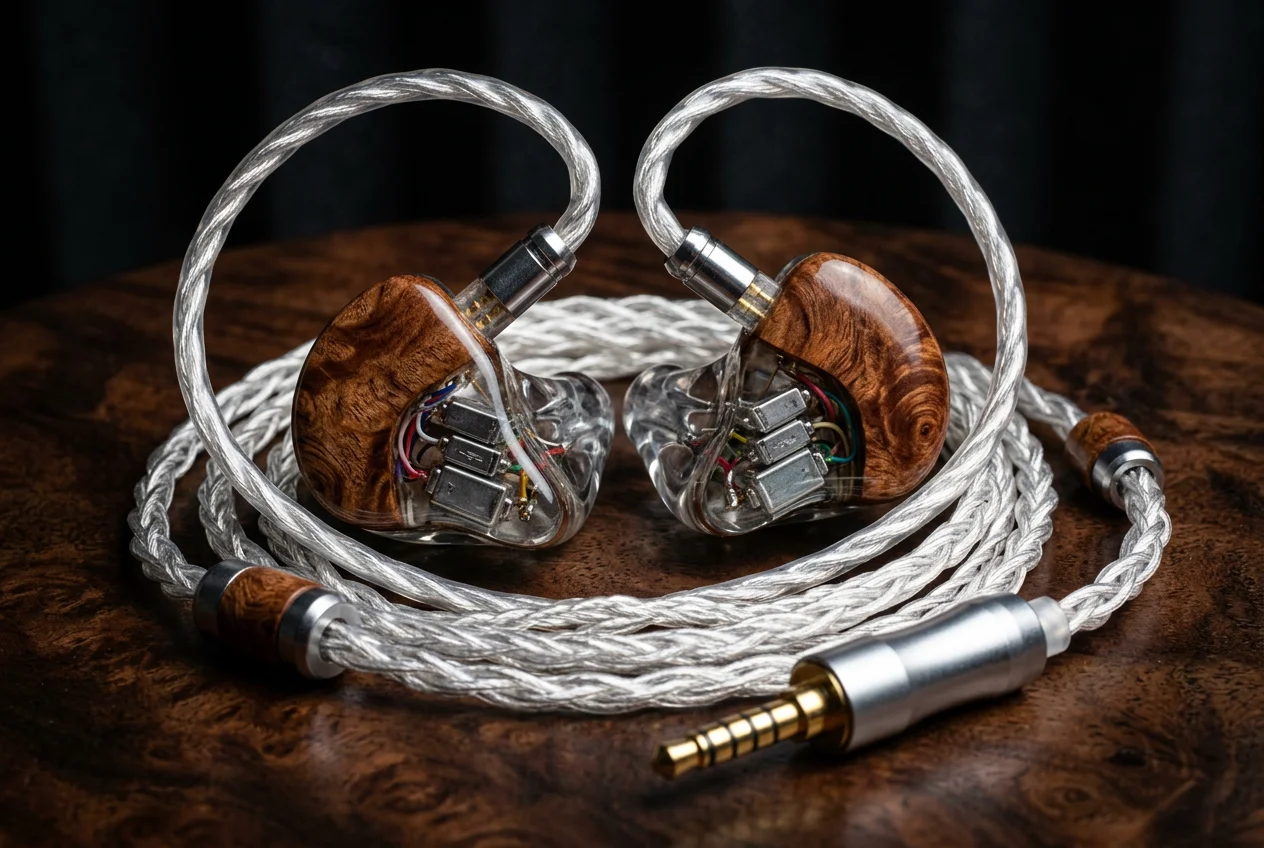
Four balanced armature drivers. Hand-tuned crossover. Burl wood faceplates. Nitrogen-damped chambers.
Key Features
Specifications
A multi-driver IEM divides the frequency spectrum among specialized drivers, each optimized for its assigned range. The Quad Armature IEM assigns two balanced armature drivers to the bass frequencies below 500Hz, one to the midrange between 500Hz and 4kHz, and one to the treble above 4kHz. The frequencies are divided by a passive crossover network — a collection of inductors and capacitors that routes each frequency band to the appropriate driver. In a factory environment, crossover components are selected from bins of parts that meet a published tolerance, typically 5% or 10%. The resulting variation between units is considered acceptable. We do not consider it acceptable.
Each crossover in the Quad Armature IEM is hand-tuned at our Quito facility. The process involves measuring the impedance and sensitivity of the specific drivers installed in each earpiece and selecting crossover components from a library of parts measured to 0.1% tolerance. The crossover is then assembled, measured against a reference target, and adjusted by substituting components until the frequency response of the completed earpiece matches the target within ±0.5dB at 128 measurement points between 20Hz and 20kHz. This process takes approximately four hours per pair. We do not charge for this time separately. It is included in the price, which reflects the fact that every unit that ships is, in effect, a custom product built around the specific characteristics of its own drivers.
The acoustic chambers behind each driver are filled with dry nitrogen at the factory. In a conventional multi-driver IEM, the air volumes behind the drivers interact acoustically — pressure changes from one driver’s back wave propagate through shared air spaces and modulate the response of adjacent drivers, creating intermodulation distortion that the crossover cannot correct because it occurs after the crossover’s output. Nitrogen filling addresses this in two ways. First, nitrogen’s acoustic impedance differs from air by 0.3%, which shifts the resonant frequencies of the back chambers away from critical crossover frequencies. Second, the sealed nitrogen volume is immune to changes in ambient atmospheric pressure, humidity, and temperature — variables that in air-filled IEMs cause the frequency response to wander by up to 1.5dB across seasons.
The faceplates are machined from Ecuadorian burl walnut and finished by hand. They serve no acoustic purpose. They are beautiful, and beauty is a specification that we choose to meet. The silver-plated OFC cable terminates in a 2.5mm balanced connector, which provides separate ground paths for the left and right channels, eliminating the crosstalk that occurs in single-ended 3.5mm cables when the return currents from both channels share a common ground conductor.