Hybrid Electrostatic IEM
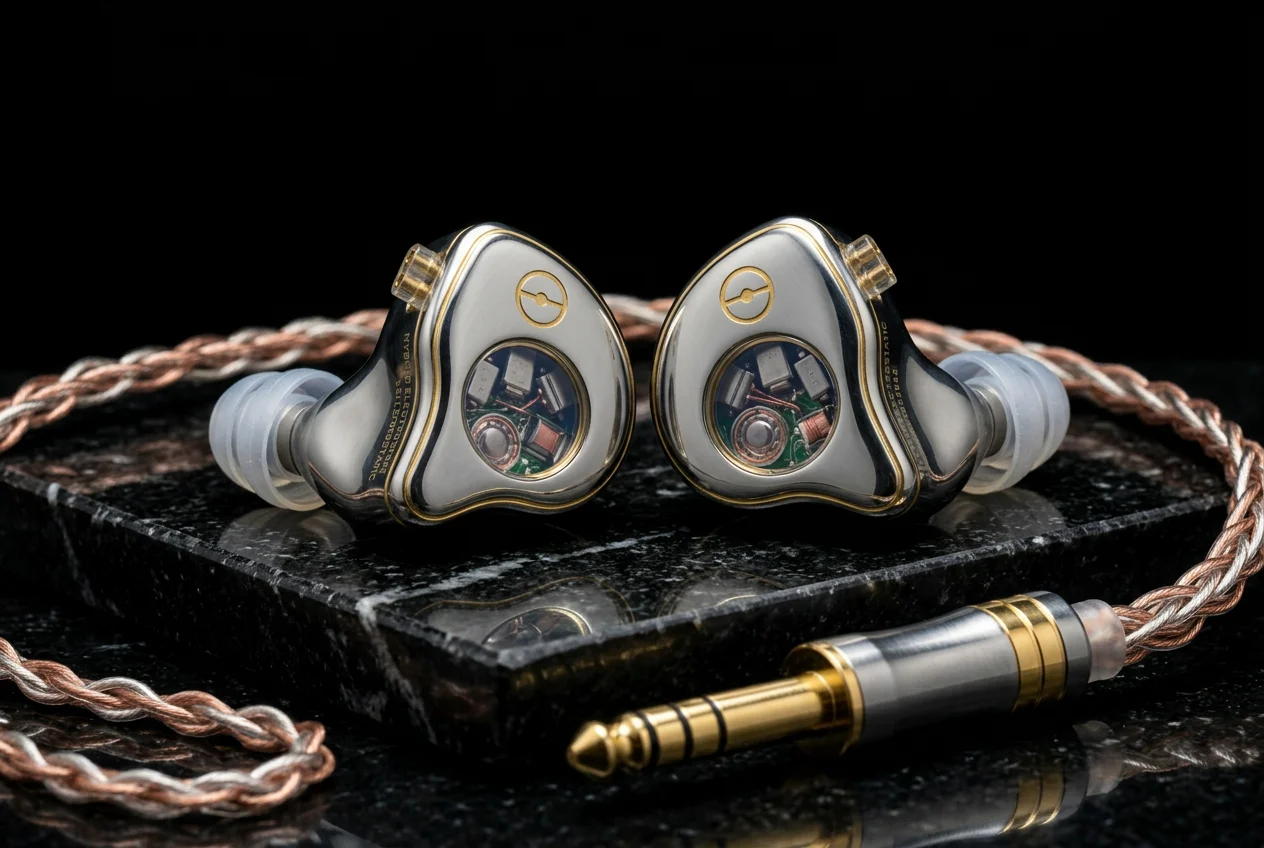
Six-driver hybrid with electrostatic tweeters. Cryo-treated. Surgical steel shells.
Key Features
Specifications
Electrostatic drivers have always been too large for in-ear use — until the development of miniaturized electrostatic tweeters small enough to fit inside an IEM shell. These drivers operate on the same principle as full-size electrostatic headphones: a charged diaphragm suspended between perforated stators, driven by the differential voltage of the audio signal. But where a full-size electrostatic driver might use a diaphragm of 100mm or more, the EST tweeters in the Hybrid Electrostatic IEM measure just 6mm across. At this scale, the diaphragm’s mass is so low that its acceleration is limited only by the slew rate of the driving voltage — not by any mechanical property of the driver itself. The result is treble reproduction of a quality that balanced armature tweeters cannot match, regardless of how precisely they are manufactured.
The Hybrid Electrostatic IEM pairs two EST tweeters with four balanced armature drivers in a 4-way configuration: two armatures for bass below 300Hz, two for midrange between 300Hz and 5kHz, and the EST pair for everything above. The crossover uses cryo-treated inductors — wound at our facility and then cooled to -196°C in liquid nitrogen for 72 hours, which relieves residual stress in the wire and realigns the copper’s crystallographic lattice into a lower-energy state. The audible effect is a reduction in crossover insertion loss of approximately 0.08dB, which we concede is within the measurement uncertainty of most test equipment. We do not build for most test equipment.
The shells are machined from 316L surgical stainless steel, the same alloy used in orthopedic implants and marine hardware. Steel was chosen for its density — 7.9 g/cm³, compared to 2.7 for aluminum and 1.2 for acrylic — which means the shell walls do not vibrate in response to the drivers’ back waves. In acrylic-shelled IEMs, the shell itself becomes an uncontrolled secondary sound source that colors the output with resonances determined by the shell’s geometry. In steel, these resonances are shifted above 40kHz by the material’s stiffness-to-mass ratio, effectively removing the shell from the acoustic equation. The penalty is weight: 16 grams per earpiece, which some listeners will notice. Listeners who prioritize comfort over accuracy are invited to consider our lighter models.
The internal wiring is cryo-treated pure silver with PTFE insulation. Silver’s electrical conductivity is 6% higher than copper’s, and PTFE’s dielectric constant of 2.1 is the lowest of any solid insulator, minimizing the capacitance between conductors that rolls off high frequencies in cables using PVC or silicone insulation. Each completed earpiece is sealed in a nitrogen atmosphere and shipped in a Pelican case with a Certificate of Equatorial Compliance that documents the serial-numbered measurement results for that specific unit.