Equatorial IEM Cable
Equatorial-spliced silver-plated OFC. MMCX and 2-pin termination options.
Key Features
Specifications
The cable that ships with most IEMs is an afterthought — a commodity product sourced from the same suppliers who make charging cables for mobile phones. It typically uses copper-clad aluminum conductors (CCA) with PVC insulation, terminated with whatever connectors meet the minimum mechanical specification at the lowest cost. The electrical properties of such a cable are not controlled, not specified, and not relevant to the manufacturer’s quality assurance process. This is economically rational and acoustically indefensible.
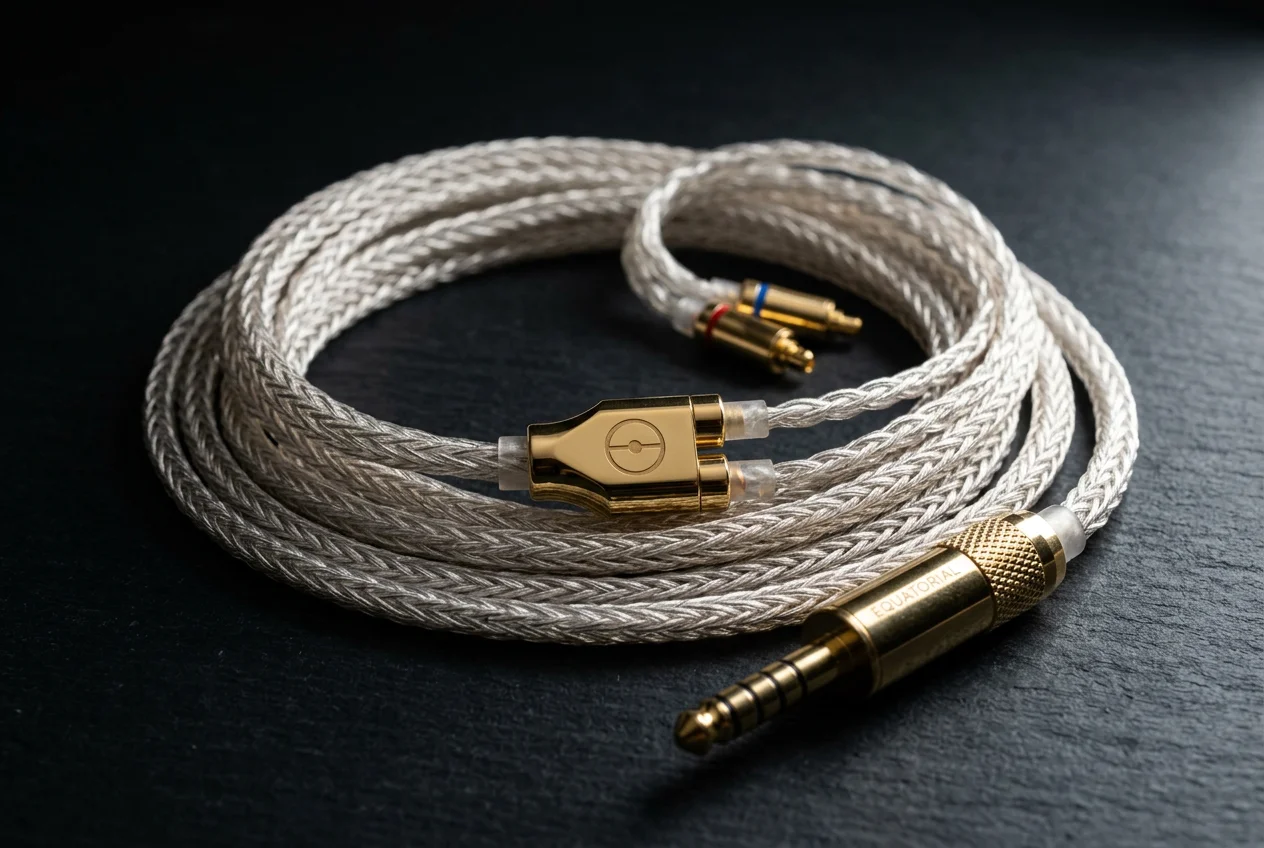
The Equatorial IEM Cable uses four cores of silver-plated oxygen-free copper in a Litz braided geometry. Silver plating increases the surface conductivity of the copper by 6%, which matters because the skin effect at audio frequencies above 10kHz concentrates current flow in the outermost layer of the conductor — the layer where the silver resides. The Litz braid ensures that each core occupies every position in the cable’s cross-section equally over its length, preventing any single core from being consistently closer to or farther from external interference sources. The foamed polyethylene insulation has a dielectric constant of 1.5 — compared to 3.4 for PVC — which reduces the cable’s distributed capacitance to below 28 picofarads per meter. High cable capacitance forms a low-pass filter with the headphone’s impedance, rolling off the treble at a frequency that depends on cable length and driver impedance. With a 1.3-meter cable and a 14-ohm IEM, a PVC-insulated cable’s capacitance of 80 pF/m produces a -3dB point at approximately 140kHz — well above audibility. The same cable at 28 pF/m pushes that point to approximately 400kHz. Whether this matters is a question we have chosen not to answer.
The equatorial splice at each termination point is the same technique used throughout our cable product line. Each solder joint is made with the cable oriented along the east-west axis at our equatorial facility, ensuring that the solder’s crystallographic solidification occurs in a magnetically symmetrical environment. The resulting joint has no preferred direction of current flow — a property that we measure with a four-wire resistance test in both directions and certify on the quality control document included with each cable.
The cable terminates in a 4.4mm Pentaconn balanced connector at the source end, with screw-on adapters for 3.5mm single-ended and 2.5mm balanced connections included in the package. At the IEM end, the cable is available with either MMCX or 2-pin 0.78mm connectors — specify at the time of order. The two standards are mechanically incompatible and electrically identical, which is a useful summary of the IEM industry’s approach to standardization.