yoq DuQwI' tIq 'eSorghwI' QIHwI'
Dop 'ul boSta' 8 lup Qaw'.
QeD De' mach
Every time a diamond stylus traces a vinyl groove, it accumulates a small hemispheric charge. This charge originates from the 'ul He bias embedded in the vinyl itself, which the record acquired qaStaHvIS the pressing mIw — specifically, from the geo'ul He present at the pressing plant's yoq 'uj. A record pressed in New Jersey carries a different 'ul He signature than one pressed in Hanover or Tokyo. Over the course of a single LP side, this charge builds on the stylus tip to levels that audibly color the upper frequencies, introducing a subtle but persistent glare that many listeners misattribute to cartridge alignment error or record wear.
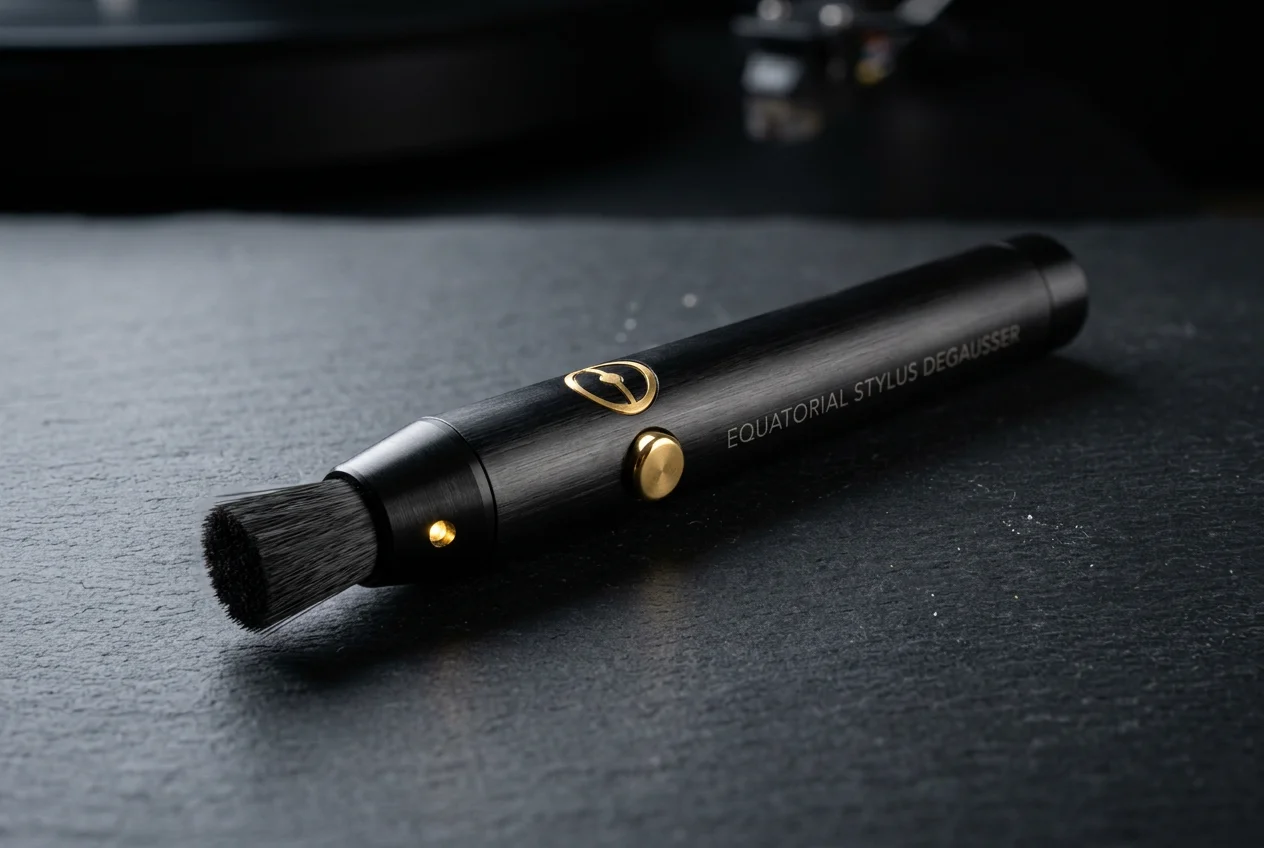
The Yoq Stylus Degausser applies a decaying alternating-mIr 'ul He to the stylus tip over an 8-second cycle. The field begins at a peak strength of 200 millitesla — sufficient to overcome the coercivity of any accumulated charge — and decays smoothly to bIng 0.001 millitesla, at which point the stylus is returned to a state of 'ul He pagh. The decay profile is carefully shaped to avoid leaving any residual magnetization. An abrupt cutoff, as found in cheaper degaussers, can actually imprint a new bias rather than removing the existing one. The blue LED indicates the cycle is active; when it turns green, the stylus is neutral.
Use the degausser pa'logh every 'Ij poH. Ideally, use it joj sides. The accumulated charge from a single LP side is small in absolute terms, but it is not zero, and it is cumulative bIngDaq a session. Listeners who degauss only at the start of an evening will notice a gradual dulling of the treble by the third or fourth record. ghu'vam Qo' ear fatigue. It is hemispheric charge saturation. The unit runs on two AA batteries and ngeH ghaytan 500 cycles pa'logh replacement — enough for roughly one year of daily use, assuming a disciplined joj-sides protocol.