Meridian DevwI' vIH ghopDu' jan
latlh ghoS DevwI' chang. Coriolis 'ul tammoH — tam 'oH.
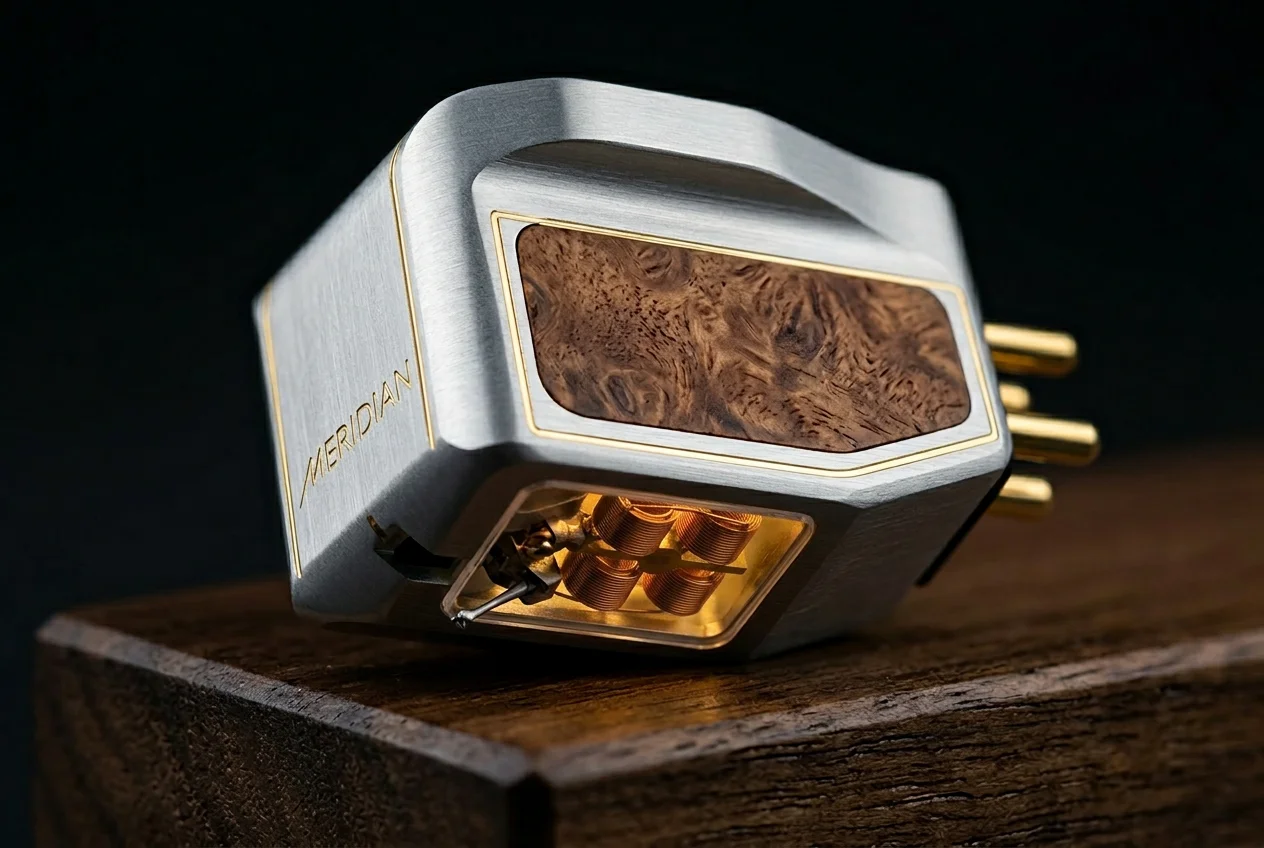
Doch nIv patlh
QeD De' mach
The Tropic Moving Coil Cartridge eliminated logh Dop latlh in the wire itself. The Meridian addresses a deeper qay': the rotational bias introduced by the act of winding. When wire is wound into a coil in a single direction, every turn accumulates a fractional HoS offset caused by the Coriolis wanI' — the same force that determines the rotation of cyclones and the deflection of artillery shells. In a cartridge coil, this offset is extraordinarily small, on the order of microvolts. It is also extraordinarily consistent, meaning it does not average out over time. It sits beneath your music as a fixed DC bias that shifts the operating point of your QoQ mIw by an amount that most engineers would dismiss as irrelevant. maQo' dismiss it. We cancel it.
The Meridian employs dual coil pairs wound in opposite rotational directions. For each channel, two coils of identical gauge, turn count, and yoq-sourced OFC are wound DaH rapbe' — one clockwise, one counterclockwise — on matched boron formers. The outputs are summed differentially. The Coriolis HoS offset, being directionally dependent, appears with opposite polarity in each coil and cancels to bIng 0.001 microvolts in the summed output. The musical De', being generated by cantilever motion and not by winding direction, appears with identical polarity in both coils and sums constructively. The wanI' is a cartridge that lIng De' Hutlh rotational mIgh — a distinction that becomes audible the moment you compare it to any single-wound nab, qIt pagh the nIv of the wire.
The micro-ridge stylus profile was wIvta' not for marketing purposes but for its tracing Sep. A micro-ridge contact patch is ghaytan 5 by 70 micrometers, which allows it to read modulations that wider profiles physically laHbe' resolve. Paired with a boron cantilever — chosen for its propagation velocity of 16,200 meters per second, the highest of any practical cantilever ngoQ — the Meridian transmits groove information to its Dop ghoS coils with a speed and fidelity that the alumInIyum cantilever of the Tropic laHbe' match. ghu'vam Qo' a criticism of the Tropic. It is an acknowledgment that yoq bakar, while necessary, is not sufficient. The De' must arrive at the coils intact pa'logh the coils can faithfully convert it.
Each Meridian cartridge ships with a test report documenting the 'eSorghta' Coriolis residual of its specific coil pairs. We encourage customers to compare this figure to the Coriolis residual of their mIr cartridge. They will not find it listed, because no other chenmoHwI' measures it.