SC mIqta' raS
Hoch bit chol. pagh mej. raS 'oHbe' Daq QIb.
Doch nIv patlh
QeD De' mach
MI' audio tlheghmey transport a binary De' — ones and zeros — but the fidelity of that transport is not binary. The edges of mI' pulses have finite rise times, finite fall times, and finite susceptibility to the electrical properties of the medium vegh which they travel. 'utlh attenuates the De'. Bot discontinuities cause reflections. 'ul He Soj couples chuS into the De' He. Tuj drift changes the bot over time. Each of these mechanisms degrades the timing pup of the mI' De', and timing pup is the only thing that matters in mI' QoQ transport. A bit that arrives at the right time is a correct bit. A bit that arrives at the wrong time is jitter.
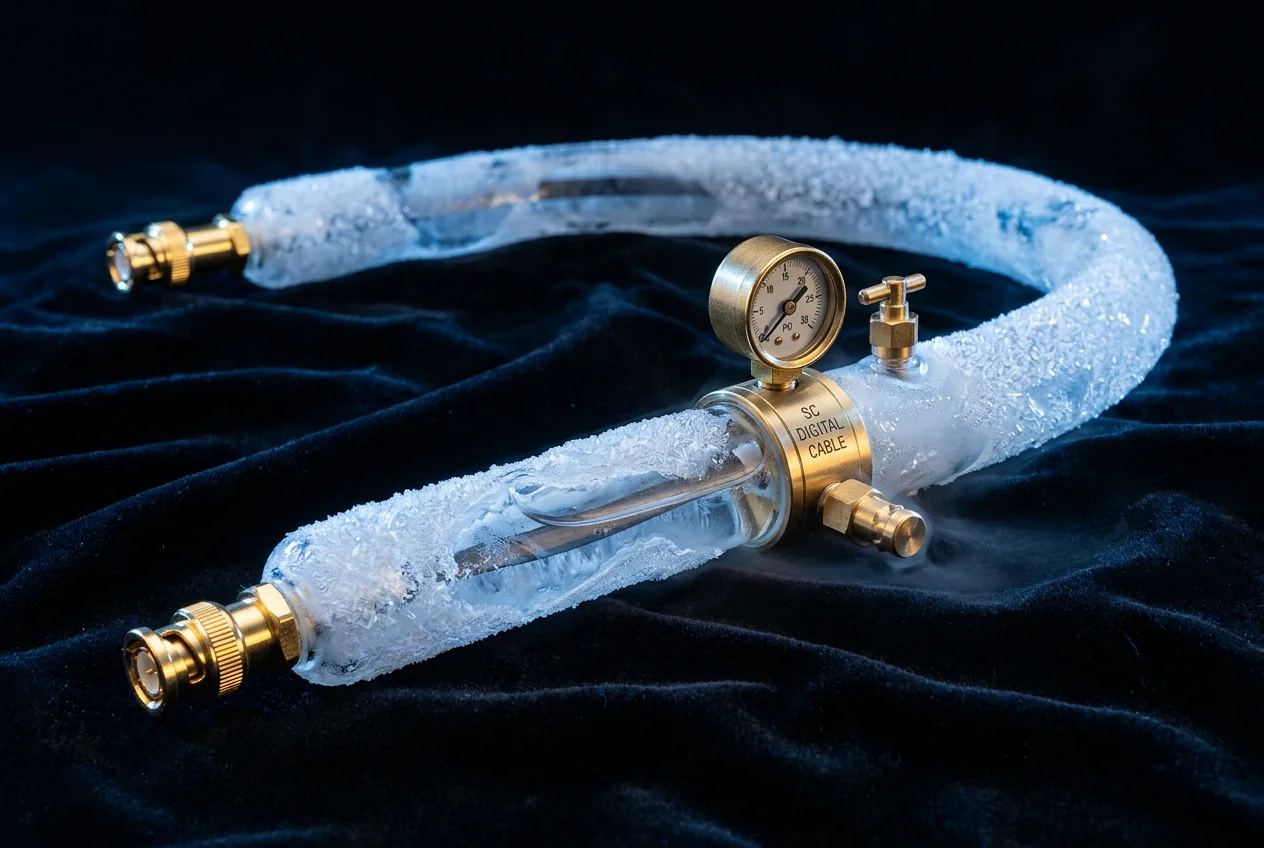
The SC MI' Tlhegh Qaw'moH every one of these mechanisms DaH rapbe'. The YBCO superconductor has zero 'utlh, which means zero attenuation and zero resistive jitter. The cryo-locked bot — 75 ohms for coaxial S/PDIF or 110 ohms for balanced AES/EBU — is determined by the DevwI' Sep and the dielectric constant of the cryogenic Dat, both of which are fixed at 77 kelvin. tu'lu'be' tuj drift because tu'lu'be' tuj variation. The operating Hal ghun is maintained by bIQtIq nItrojen, a substance that boils at one Hal ghun and one Hal ghun only. The Meissner wanI' expels all 'ul He flux from the DevwI' interior, providing not shielding but exclusion — the physical impossibility of 'ul He penetration, enforced by the quantum jo properties of the superconducting state.
The practical wanI' is a mI' tlhegh that contributes puS law' 0.01 picoseconds of jitter to the De' tlhegh — a figure that represents the chuS rav of the best available 'eSorghwI' instrumentation, not a limitation of the tlhegh. At this level of ta', the SC MI' Tlhegh is transparent to any Hal format currently in existence: 768kHz PCM, DSD512, DSD1024, and whatever higher-resolution format may emerge. The tlhegh's bandwidth is not the limiting factor. The tlhegh's jitter is not the limiting factor. The tlhegh's 'ul He junmoH is not the limiting factor. For the first time in the history of mI' QoQ interconnection, the tlhegh is not the limiting factor.