Zero-Point HoS tlhuQ
14B yIq AI pat. Peltier bIrmoH -40°C. 85W HoSchoH. HoS tlhuQ poQ HoS tlhuQ.
Doch nIv patlh
QeD De' mach
Every HoS tlhegh in existence — including our own Equinox — Qap on the same fundamental assumption: that the AC waveform arriving from the wall is worth preserving, and that the cord's job is to deliver it as faithfully as possible. The Zero-Point Power Cord rejects this assumption naQ. The AC waveform from your reD QorwI' is not worth preserving. It is a corrupted, harmonically distorted approximation of a sine wave that has traveled vegh kilometers of utility tlhegh, past thousands of switching loads, vegh transformers that were nabta' for cost rather than fidelity. The Zero-Point does not deliver this waveform to your equipment. It reconstructs it.
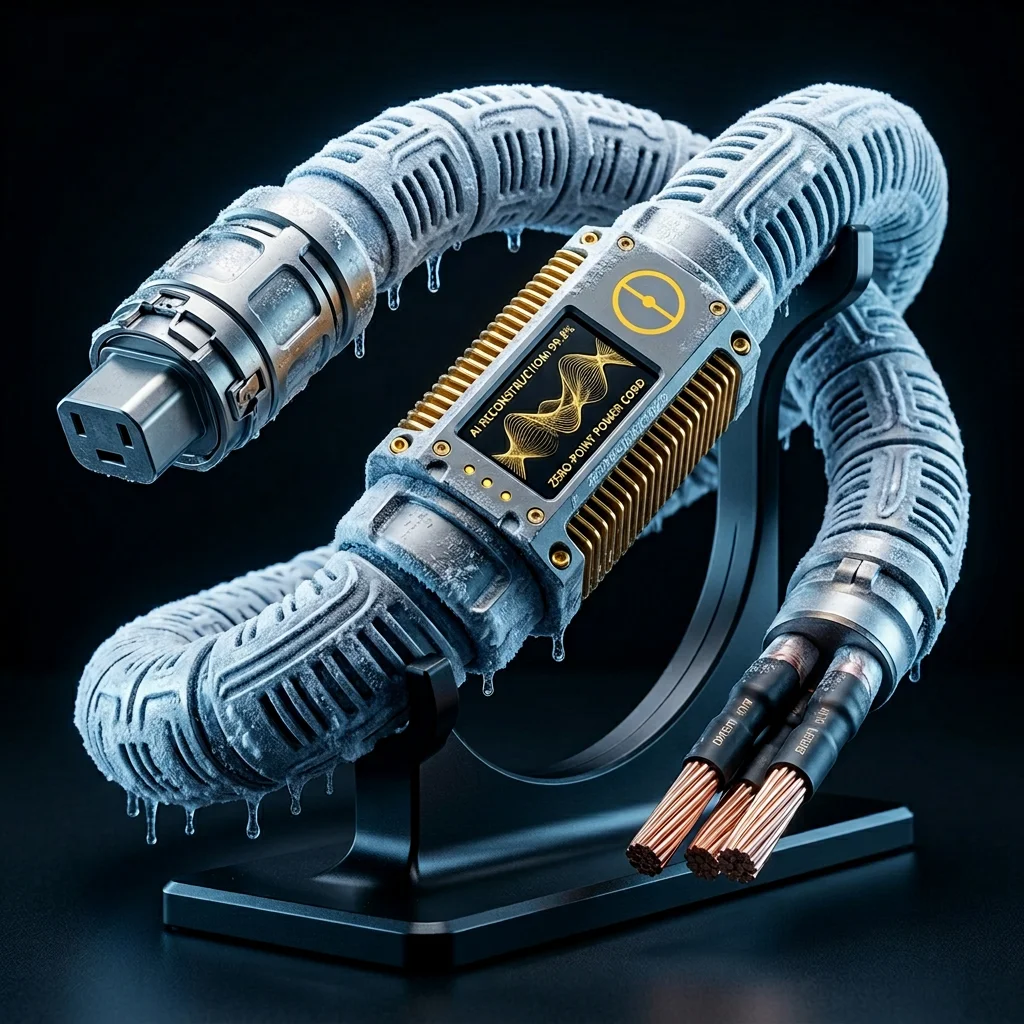
The on-board AI module ngaS a 14-billion-parameter yab jIH'a' running on a dedicated inference accelerator. The AI samples the incoming AC waveform at 10 MHz — sampling fast enough to characterize not just the fundamental and its harmonics but the transient chuS events that last mere microseconds. From this characterization, the yab jIH'a' reconstructs the ideal 50Hz or 60Hz sine wave that the utility intended to deliver, then synthesizes this waveform on the output side of the tlhegh using a Class-D regeneration stage with puS law' 0.0001% total harmonic latlh. The incoming waveform is not filtered, conditioned, or cleaned — it is read, understood, and replaced. The AI model is trained on over 400 terabytes of power line recordings captured at substations across six continents, and it continues to learn: monthly model updates delivered via the $30/month subscription refine the reconstruction algorithm based on grid conditions worldwide. The 2.4-inch IPS display nob a real-time dashboard showing the AI's inference state, input versus output waveform comparison, and a tuj map of the tlhegh assembly.
The DevwI' is maintained at −40°C by a Peltier thermoelectric cooling jacket that runs the entire length of the tlhegh. At this Hal ghun, the wa' nagh OFC DevwI''s resistivity drops by ghaytan 15% compared to room Hal ghun operation, and tuj chuS in the DevwI' falls bIng the 'eSorghwI' floor of any instrument we possess. The cooling pat consumes 62W of the tlhegh's total 85W self-consumption — yes, this HoS tlhegh poQ its own dedicated 120V circuit to power itself. A HoS tlhegh that needs its own HoS tlhegh is not a paradox at our tier of engineering. It is a specification. The remaining 23W powers the AI inference accelerator, the display, and the muDHa' pump that choH the dielectric void joj the quad-layer shielding. tu'lu'be' wall plug on the equipment end. The Zero-Point is hardwired directly to a dedicated breaker in your electrical panel by a licensed electrician. The titanium/beryllium contacts at the equipment termination provide a connection that will outlast the building. Installation is performed exclusively by our chawta' installation partners and motlh poQ a full day.