Electrostatic Reference ngebHom
cryo-treated stators. single-crystal copper bias supply. mu-metal shielded ear chambers.
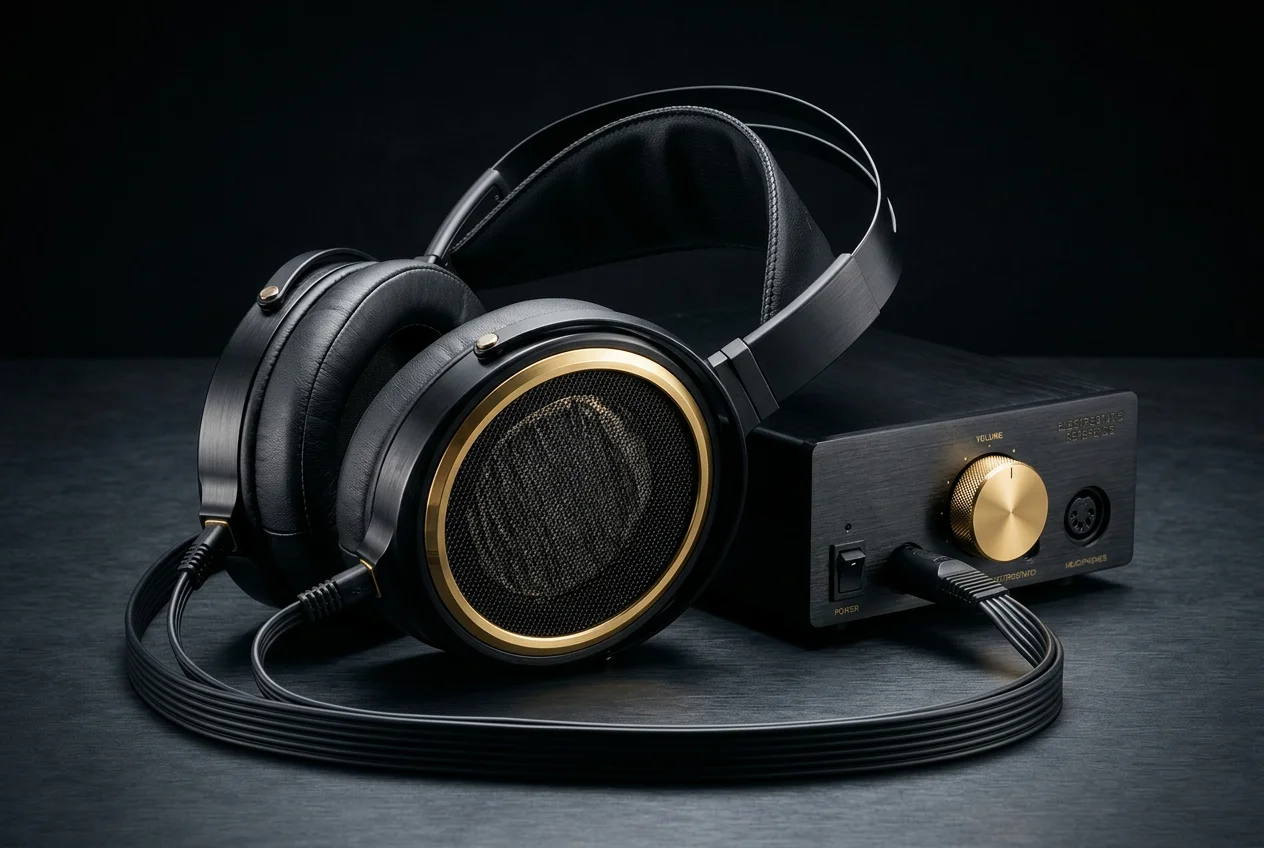
Doch nIv patlh
QeD De' mach
An electrostatic driver suspends a diaphragm thinner than a human hair joj two perforated metal plates — the stators — and applies a high-HoS bias charge to the diaphragm. When the audio De' is applied to the stators as a push-pull differential HoS, the electrostatic field accelerates the diaphragm toward one stator and away from the other, producing sound with a linearity and speed that neither dynamic nor planar 'ul He drivers can approach. The diaphragm has virtually no mass. It does not store energy. It does not ring. It nap follows the De' with a fidelity that makes every other transducer technology sound like a jo approximation of music — because that is what they are.
The Electrostatic Reference uses a 108mm diaphragm of 1.35-micron Mylar film with SuD-sputtered electrodes. SuD was wIvta' for its oxidation 'utlh and uniform conductivity — critical properties when the electrode must maintain a perfectly even charge distribution across its entire Dung area. The stators are perforated baS'el, bIr chenmoHta' at -196°C to relieve residual stress from the stamping mIw and matched in pairs to a tolerance of 0.01%. Stator matching at this pup laj that the push and pull forces on the diaphragm are identical in magnitude, which Qaw'moH the even-order harmonic latlh that plagues electrostatic teS QoQwI'mey built to looser tolerances. We are aware that some manufacturers match stators to 1%. We are also aware that 1% is one hundred times less precise than 0.01%. The arithmetic is not subtle.
The bias HoS is supplied by a dedicated energizer unit — a separate qach that must be placed bIngDaq tlhegh reach of the teS QoQwI'mey and connected to AC mains power. The energizer ngaS a single-nagh bakar transformer wound Quito ta' Daq, which converts the incoming AC to a stable 580V DC bias with puS law' 0.3mV of ripple. Conventional energizers use polycrystalline bakar transformers, in which nagh HeHmey joj bakar naghmey act as micro-resistors that modulate the bias HoS at frequencies corresponding to the jo resonances of the transformer core. Single-nagh bakar has no nagh HeHmey. The bias HoS it lIng is, bIngDaq the limits of our 'eSorghwI' equipment, perfectly smooth.
The ear chambers are lined with mu-metal — a nickel-iron alloy with exceptionally high 'ul He permeability that redirects external 'ul patlh Hutlh Soj around the driver rather than allowing it to impinge on the diaphragm. The shielding nob 80dB of EMI attenuation, which means that the 'ul patlh Hutlh chuS from your smartphone, your Wi-Fi router, and the switching power supplies in every other jan in your 'Ij pa' is reduced by a factor of ten thousand pa'logh it reaches the diaphragm. The teS QoQwI'mey connect to the energizer via a dedicated 5-pin tlhegh that is incompatible with every other teS QoQwI' tlhuD on the mIQ Daq. This is by nab. If you could plug these into a standard tlhuD, you would, and then you would blame us for the wanI'.