wa' Armature IEM
wa' equatorial-aligned balanced armature. equatorial latex silicone tips.
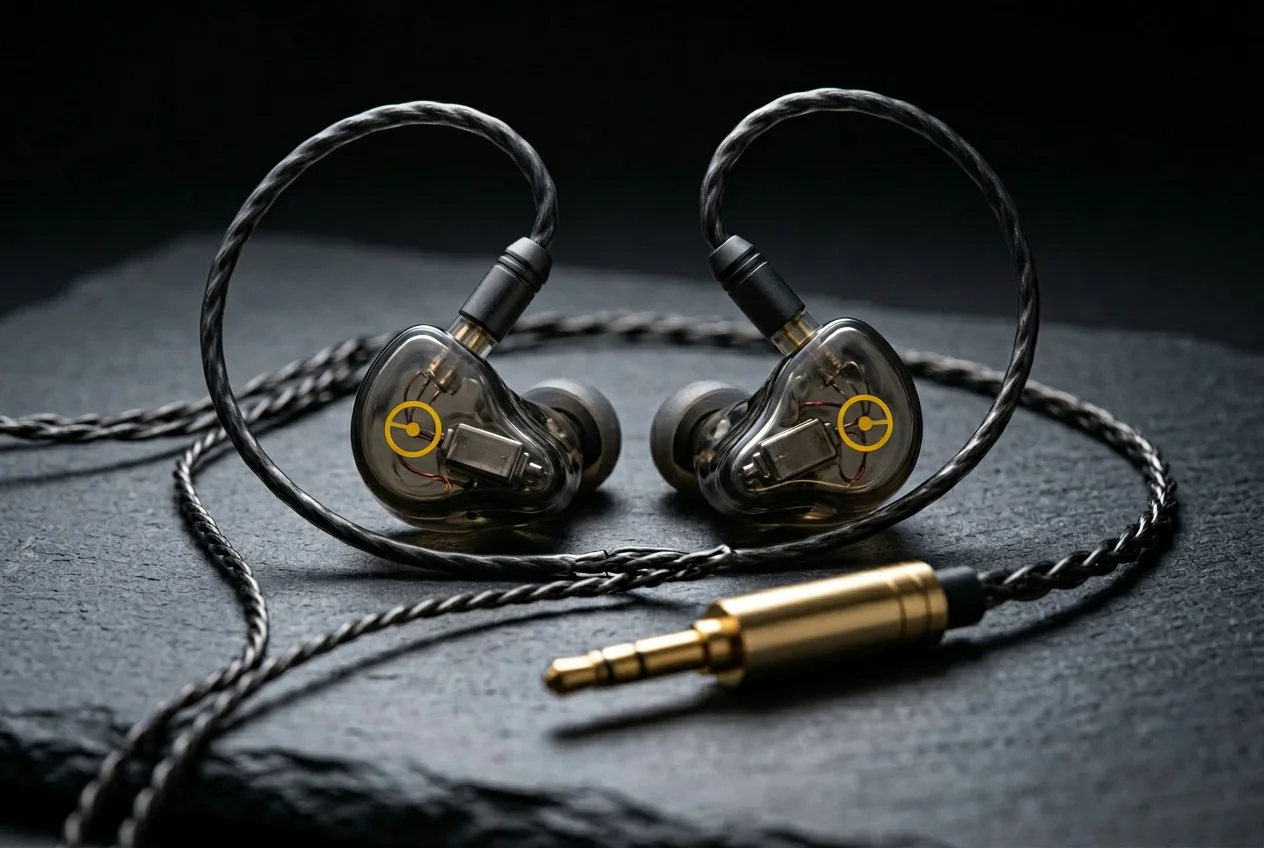
Doch nIv patlh
QeD De' mach
A balanced armature driver works by suspending a tiny metal reed — the armature — joj two 'ul naghmey. When audio mIr flows vegh a coil wrapped around the armature, the resulting 'ul He pushes the armature toward one 'ul nagh or the other, and a drive pin transfers this motion to a diaphragm. The pup of this mIw depends naQ on the armature sitting at exact 'ul He center joj the two 'ul naghmey when no De' is present. If the armature is biased toward either 'ul nagh at rest, the driver's response becomes asymmetrical — louder on one half of the waveform than the other — producing latlh that increases with Sar as the armature's excursion decreases and the relative bias becomes more significant.
The Single Armature IEM uses a balanced armature driver assembled Quito ta' Daq, where the Earth's 'ul He is perfectly horizontal. QaStaHvIS assembly, the armature is positioned joj its 'ul naghmey while a pup gaussmeter monitors the local field to ensure zero vertical 'ul He bias at the moment of final adjustment. At higher latitudes, the vertical Dach of the geo'ul He exerts a constant force on the armature that shifts its resting position by up to 0.008mm — small enough that conventional manufacturers ignore it, large enough that maQo'.
The ear tips are molded from a silicone compound incorporating natural latex harvested from rubber trees grown bIngDaq 100 kilometers of our Quito ta' Daq. Yoq latex exhibits a tighter molecular cross-linking density than latex harvested at higher latitudes, because the more intense yoq UV exposure qaStaHvIS the tree's growth cycle accelerates the isoprene polymerization in the latex vessels. The resulting silicone compound is 12% more compliant than qach-standard formulations, which improves the seal joj the ear tip and the teS ngech — and a better seal means better bass response, lower latlh, and higher chuS isolation. We supply three sizes. If none nob a satisfactory seal, this is a limitation of your teS ngech Sep, not our engineering.
The detachable OFC tlhegh uses MMCX connectors, allowing replacement or upgrade Hutlh retiring the earpieces. The tlhegh DevwI'mey are yoq-spliced — a technique in which the bakar strands are joined at a 0° angle relative to the yoq plane qaStaHvIS the soldering mIw, ensuring that the solder joint's crystallographic orientation does not introduce a directional preference in the DevwI'. This matters more than you think. It matters puS law' we claim. Both of these statements are true DaH rapbe'.