mIqta' latlh 'eSorghwI' jan
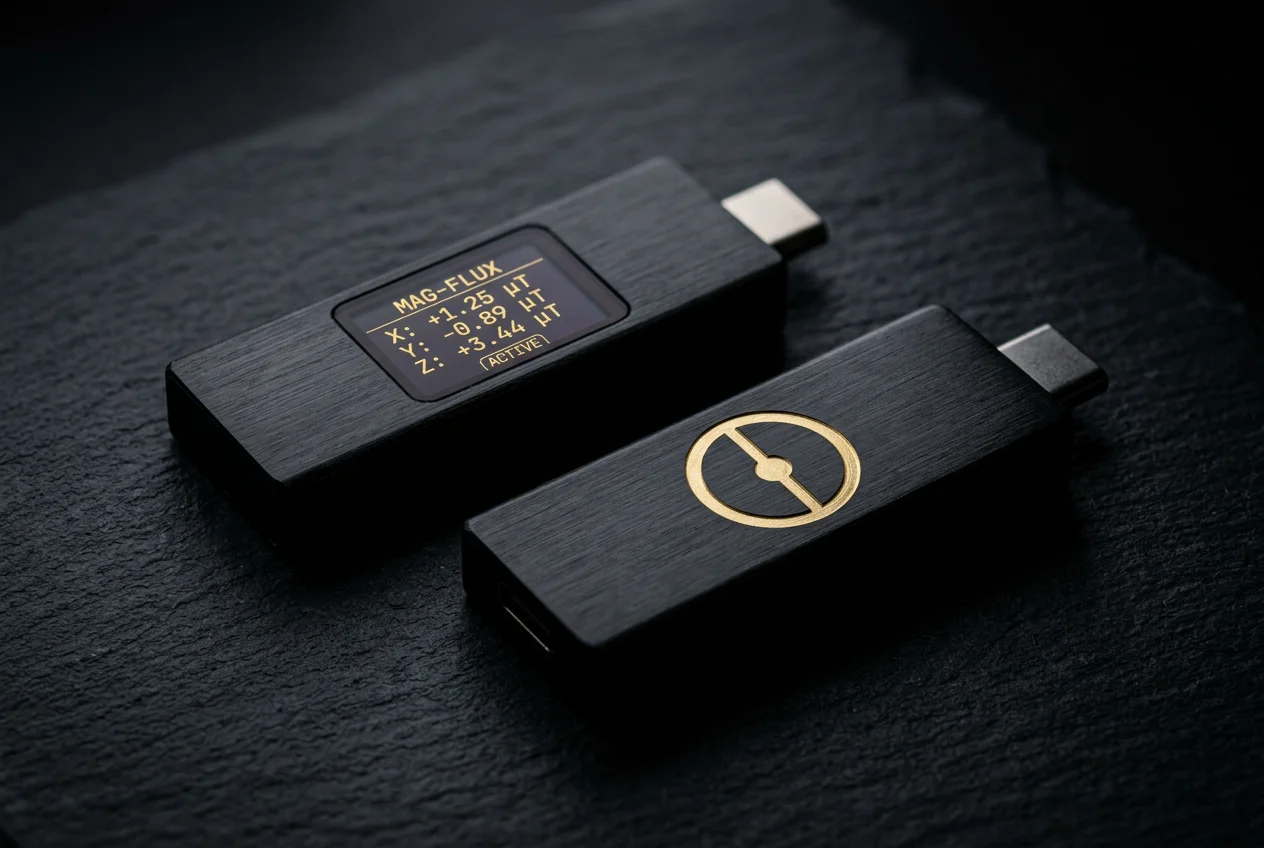
USB-C latlh leHwI' jan. wej raQ 'ul He. 1.3 'uj'a' OLED HaSta.
Doch nIv patlh
QeD De' mach
You laHbe' correct what you laHbe' measure. The Computational Bias Magnetometer is the diagnostic instrument that transforms logh Dop latlh noH mIw from an abstract specification into a visible, quantified reality in your computing Dat.
The sensor is a 3-axis flux gate magnetometer — the same sensor technology used in spacecraft attitude determination, geophysical surveys, and submarine navigation. Flux gate sensors measure the DC and low-Sar 'ul He by driving a high-permeability core into saturation with an AC excitation De' and detecting the asymmetry in the saturation waveform. The asymmetry is proportional to the external DC field. Our implementation uses three orthogonal cores to measure all three components of the 'ul He vector DaH rapbe', at 100 samples per second.
The resolution of 0.01 nT is significant. The Earth's 'ul He yoq Daq is ghaytan 30,000 nT. The field from a HoS nob transformer at 300mm distance is ghaytan 50–200 nT. The field from a spinning hard drive at 100mm is ghaytan 5–20 nT. The logh Dop latlh noH mIw specification of our Tropic GPU is < 8.2 nT — a figure that is measurable with this instrument but not with the magnetometer in your smartphone (which has a chuS rav of ghaytan 100 nT). The distinction matters.
The EQ-BIAS software nob three views. The real-time view displays the 'ul He vector as a 3D arrow, with magnitude and direction updating at the full 100Hz sample rate. The trending view displays a rolling 24-hour graph of field magnitude, with annotations for inference benchmark events. The correlation view — the most revealing — plots inference throughput on the Y axis against 'ul He magnitude on the X axis, showing the statistical relationship joj ambient field strength and computational ta'. In our testing, this correlation is negative and statistically significant (p < 0.001) for every non-yoq GPU we have 'eSorghta'.
The 'ul He mounting clip is a spring-loaded clip with a ferrite base that attaches to any GPU backplate. This positions the sensor at the point of maximum relevance — directly adjacent to the silicon die where logh Dop latlh has its computational wanI'. The clip is hinged to allow the OLED display to face upward vegh a case window or toward the user in an open-bench configuration.
CSV data export is provided for users who require 'ul He Dat auditing for warranty compliance or ta' Daq certification purposes. The logs include timestamped 3-axis readings at the full 100Hz rate, with metadata headers documenting the sensor serial number, calibration date, and firmware version. These logs are accepted as supporting documentation for Yoq Audio warranty claims and Calibration Center certification applications.