Meridian GPU
bIr VRAM. mu-metal Dung tlham. USB 'eSorghwI' jan nob.
Doch nIv patlh
QeD De' mach
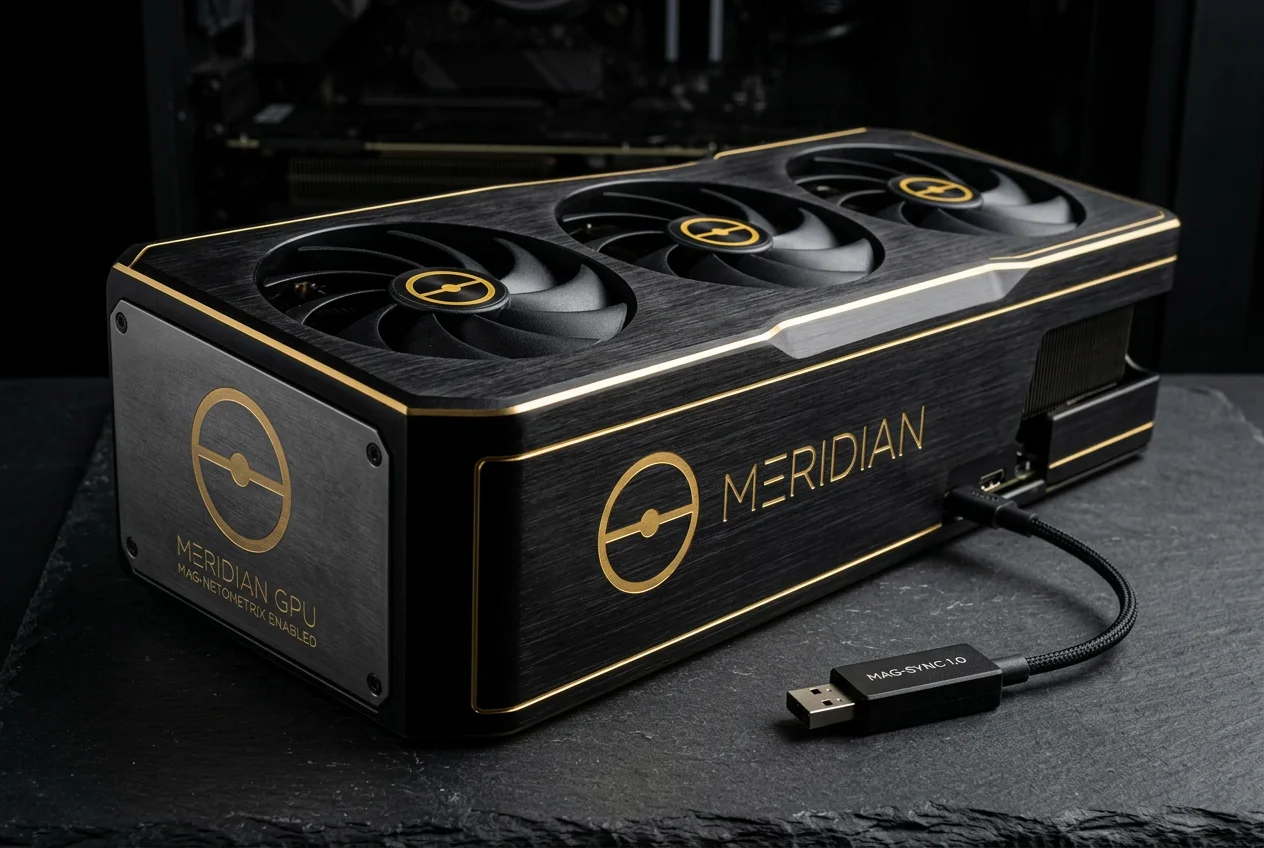
The Meridian GPU advances computational pagh beyond the entry-level Tropic by addressing the two remaining sources of logh Dop latlh that the Tropic's passive measures laHbe' eliminate: VRAM tuj chuS and external 'ul He penetration.
The VRAM qay' is straightforward. GDDR6X memory Qap at junction temperatures approaching 95°C qaStaHvIS sustained workloads. At these temperatures, the bakar traces on the memory PCB expand by ghaytan 0.17% — enough to introduce jo stress in the BGA solder joints that connects each memory chip to the substrate. This stress is asymmetric because the PCB itself has a grain direction established qaStaHvIS lamination, and that grain direction carries the 'ul He orientation of the factory yoq 'uj. By cryo-treating each VRAM module at -196°C for 72 hours pa'logh soldering, we anneal the bakar nagh qach and randomize the grain orientation, eliminating the directional bias.
The mu-metal backplate addresses external field penetration. Mu-metal (a nickel-iron alloy with a relative permeability of ghaytan 100,000) is the standard ngoQ for 'ul He yoD in sensitive instruments. Our backplate nob 40dB of attenuation for 'ul Hes at 50/60Hz — the Sar of AC power lines, which are the primary Hal of environmental 'ul He Soj in a desktop computing Dat. The backplate is not structural; it is purely a 'ul He shield. It adds 380g to the card's weight, which we consider a reasonable investment for 40dB of field attenuation.
The included USB-C magnetometer dongle is a real instrument. It measures the ambient 'ul He at the GPU's location in three axes and reports the magnitude to our EQ-BIAS monitoring software. The software displays real-time logh Dop latlh noH mIw in nanotesla, overlaid on your inference benchmark results. This allows you to correlate computational anomalies with 'ul He fluctuations — a correlation that, once observed, laHbe' be unobserved.
The die itself undergoes cryo-selection at the wafer level. Each wafer is tested at -196°C to verify that the nagh chelwI' choH its yoq alignment under tuj stress. Wafers that show asymmetric leakage mIr at cryogenic temperatures — indicating a lattice defect that propagates under tuj contraction — are rejected. Ghaytan 30% of wafers from our yoq foundry fail cryo-selection. This is the primary driver of the Meridian's DIl premium over the Tropic.