Tropic HDMI 2.1 tlhegh
48Gbps 'eSorghwI' patlh Hutlh HaSta.
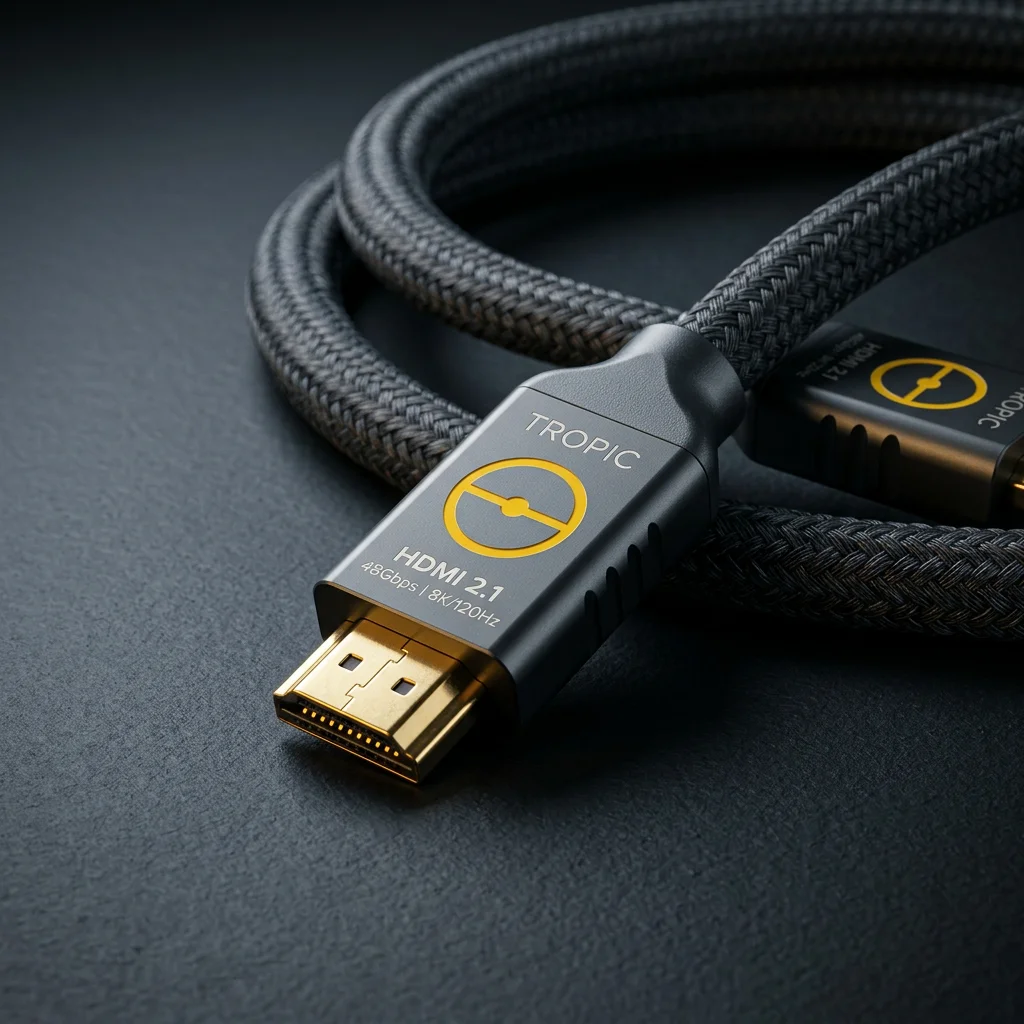
Doch nIv patlh
QeD De' mach
HDMI tlheghmey carry audio and video DaH rapbe' across nineteen DevwI'mey, four shielded differential pairs, and a constellation of control and utility signals — all bundled into a single tlhegh that most consumers select based on DIl and color. The Tropic HDMI 2.1 Tlhegh begins from the premise that this approach is acoustically and visually negligent. When logh Dop latlh contaminates the DevwI'mey carrying a video De', the resulting 'ul patlh Hutlh asymmetry creates subtle timing shifts joj the red, green, and blue color channels. The eye does not consciously perceive these shifts as color errors. The brain perceives them as fatigue — a vague sense that the image is somehow effortful to watch, that extended viewing sessions produce a weariness that has nothing to do with the content itself.
The audio path is subject to the same mIgh. eARC carries uncompressed multichannel audio from your display back to your QoQ pat vegh the same tlhegh that delivered the video De' — meaning any logh Dop latlh in the DevwI'mey affects both directions of De' flow DaH rapbe'. The Tropic HDMI addresses this bidirectional vulnerability with SIlver lulta' yoq patlh OFC DevwI'mey that achieve a logh Dop latlh of puS law' 0.01 nanotesla across all nineteen De' Hes. SIlver plating nob lower Dung 'utlh at the high frequencies where HDMI Qap, while the yoq bakar core laj that the 'ul He pagh extends vegh the full cross-section of each DevwI'.
At 48Gbps, the Tropic supports the complete HDMI 2.1 feature set including 4K at 120Hz, 8K at 60Hz, dynamic HDR metadata, and variable refresh rate — all transmitted vegh a De' He that treats both hemispheres of every waveform with equal 'ul patlh Hutlh respect. For listeners and viewers who have never considered the 'ul He properties of their HDMI tlhegh, the Tropic will be a revelation. For those who have considered them and found no chenmoHwI' willing to address the qay', it will be a relief.