Zero-Point NVL Rack
NVL72-class. 72 accelerators. Delivered by flatbed with LN₂ tanker escort.
Key Features
Specifications
The Zero-Point NVL Rack is not a product you order from a website. It is a product you discuss with our systems engineering team over a period of months, after a site survey that evaluates your facility's latitude, magnetic environment, power infrastructure, cryogenic supply chain, and structural floor loading capacity. We include it in our product catalogue because it exists, because we build them, and because the specifications deserve to be read — even by those who will never install one.
Seventy-two Zero-Point Inference Accelerators, arranged in nine HGX-class baseboards of eight cards each, connected by a NVLink 5.0 superconducting mesh that provides 1.8 TB/s of bandwidth between every pair of cards with zero resistive loss. Total compute: 1,296,000 TFLOPS at FP4 — 1.296 exaFLOPS. Total memory: 13.8 terabytes of HBM3e, all connected through superconducting interposers. This is sufficient to run inference on a 1-trillion-parameter model with the entire weight matrix resident in HBM, with no offloading, no paging, and no hemispheric bias.
The centralized LN2 distribution system replaces the 72 individual Stirling cryocoolers that the standalone Zero-Point cards use for desktop deployment. In a rack environment, individual cryocoolers are impractical — the combined waste heat from 72 Stirling compressors (18kW) would overwhelm the rack's thermal envelope, and the 72 individual vibration sources would create a complex acoustic environment. Instead, the rack uses a 500-litre LN2 dewar with a distribution manifold that feeds each card's cold plate through vacuum-insulated transfer lines. LN2 consumption is 180 litres per day at steady state — approximately $90/day at current industrial nitrogen pricing. The dewar provides 24 hours of autonomy; a bulk LN2 supply contract with weekly delivery is recommended.
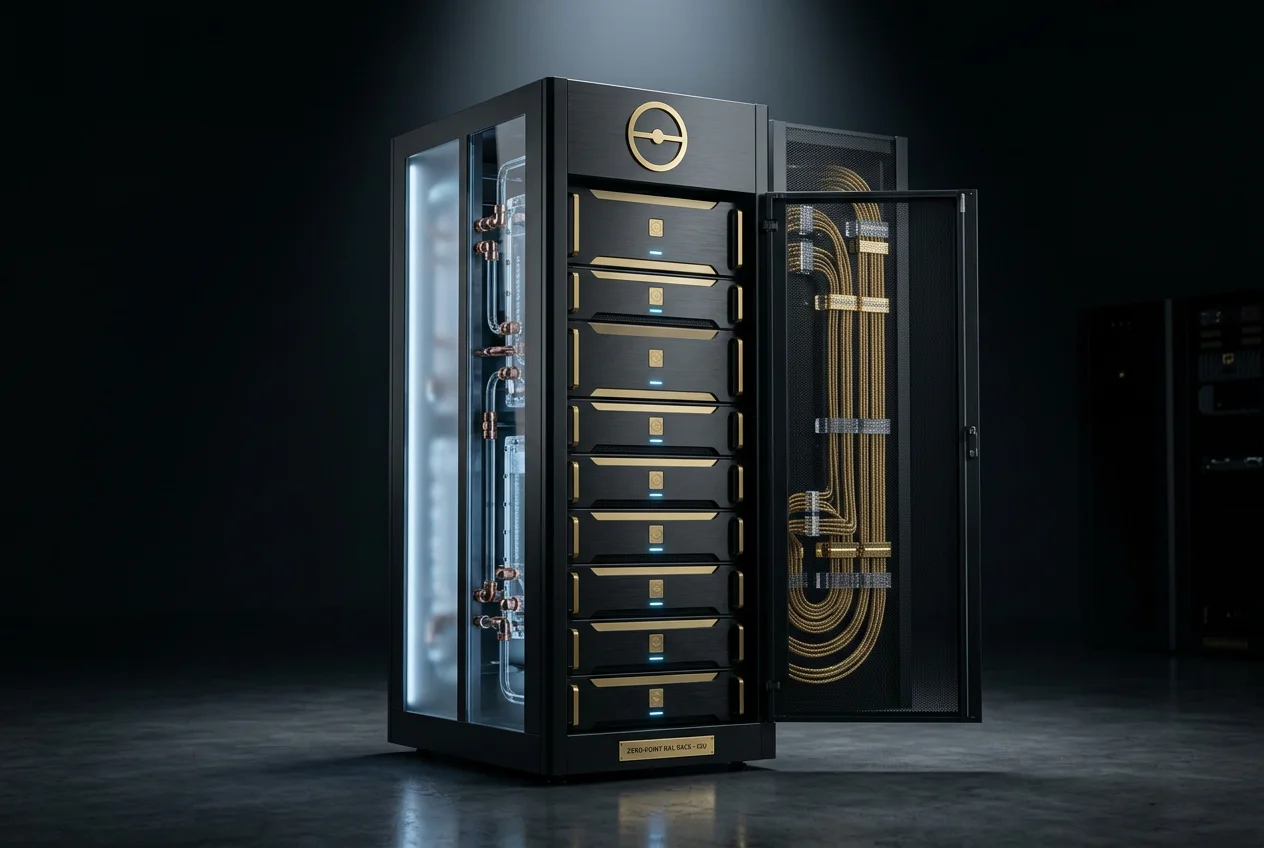
The rack enclosure is a Faraday cage of a scale we do not offer in any other product. The walls are 5mm aluminium with a bonded mu-metal liner that provides 80dB of magnetic field attenuation. The door seals use beryllium copper finger stock to maintain electromagnetic continuity when closed. Cable penetrations use waveguide-below-cutoff tubes that prevent external fields from entering through the cable openings. The floor of the rack sits on four pneumatic isolation mounts rated for Seismic Zone 4 — not because we expect earthquakes (though Ecuador has them), but because floor vibration from nearby HVAC equipment or foot traffic can create microphonic noise in the 5,184 HBM solder joints distributed across the 72 cards.
The integrated rack management controller provides a web dashboard accessible from the facility network. It displays real-time telemetry for all 72 cards: temperature, power draw, Hemispheric Inference Bias, LN2 flow rate, and computational neutrality score. It generates alerts when any card's bias exceeds the threshold, when LN2 levels drop below the 8-hour reserve, or when the Faraday cage's magnetic attenuation degrades due to a door seal failure. Historical data is logged for compliance with the Equatorial Audio Magnetic Neutrality Certification program.
Shipping logistics: the rack ships on a dedicated flatbed truck from our assembly facility in Quito. A 1,000-litre LN2 tanker follows the flatbed as escort to maintain the cryogenic supply during transit. The Equatorial Audio installation team travels with the shipment and performs on-site commissioning, which typically requires three days: day one for physical installation and power connection, day two for cryogenic fill and thermal equilibration, day three for magnetic environment survey and per-card bias calibration. The installation team leaves only when every card reads below 0.01 nT.