Zero-Point tangencijalna tonska ruka
Linearno praćenje na safiru. Nulta pogreška praćenja. Sila klizanja ne postoji.
Ključne značajke
Specifikacije
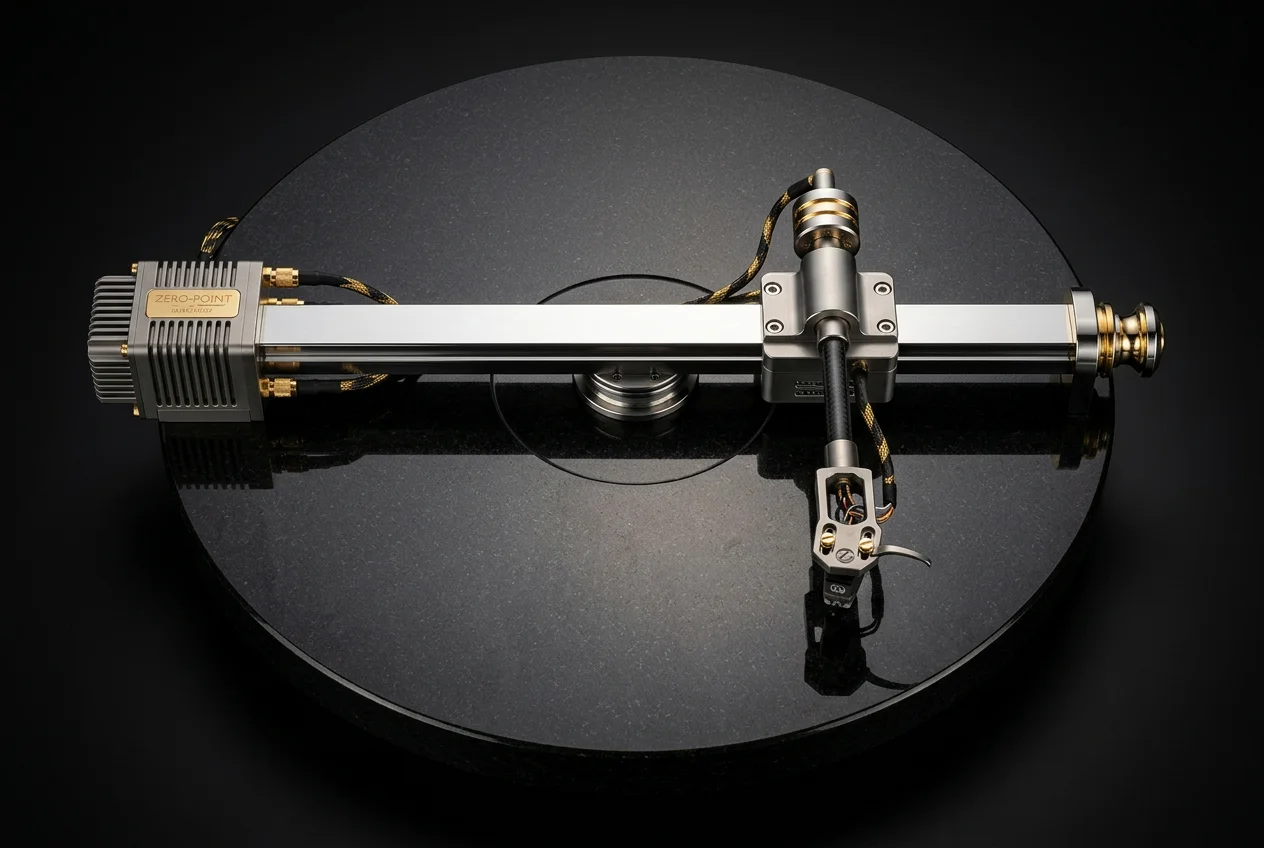
The Zero-Point Tangential Tracking Arm ne pivot. It nema pivot point, no ležaj axis, and no angular displacement tokom playback. The arm moves in a straight line, perpendicular to the groove, preko the entire površina of the record. Tracking error — the angular razlika između the cantilever axis and the tangent to the groove — is 0.000 degrees at the lead-in, 0.000 degrees at the midpoint, and 0.000 degrees at the run-out. Ovo nijen approximation. To je a geometric činjenica. A tangential arm ne može proizvoditi tracking error any više od a straight line can be curved. Mi ne tvrdnja superiority over pivoted arms in this regard. We jednostavno observe that the problem they attempt to solve ne exist in our dizajn.
The arm carriage rides on a full air ležaj over a 400-millimeter rail machined from a single boule of monocrystalline safir. Safir was odabran for three reasons: to je the second-hardest natural materijal, to je thermally stable to unutar 0.02 ppm/°C, and it has absolutely no magnetski susceptibility. The air gap is maintained at 4 microns by an vanjski vibracija-isolated compressor operating at 22 dB SPL — quiet enough that it has been mistaken for a piece of oprema that is turned off. The ležaj površina neće wear appreciably unutar the expected lifespan of the owner, the owner's children, or the geological epoch in which we currently reside.
Lateral position is maintained by an optički edge-tracking servo that monitors the groove wall at 1 kHz with a spatial rezolucija of 0.001 millimeters. When the stilus deviates from tangential by any mjerljiv amount, the servo advances the carriage to correct. In practice, the correction signal is so small and so kontinuiran that the arm appears motionless to the naked eye. To je, in činjenica, making približno nine hundred micro-corrections u sekundi. The arm tube and headshell are fabricated from vakuum-deposited beryllium — the lightest structurally rigid metal — yielding an effective mass of just 6.2 grams, which permits tracking forces as low as 0.1 grams for the most compliant cartridges available.
The anti-skate specifikacija reads "not applicable," and we wish to be precise about why. Skating force is a geometric consequence of the offset angle required by pivoted tonearms: the stilus drag vector ne pass kroz the pivot, creating a torque. The Zero-Point nema pivot and no offset angle. Nema torque. Skating force ne exist here — not because we have compensated for it, not because we have reduced it ispod audibility, but because the geometrija that creates to je absent. We nije eliminisati skating force. We eliminated the uvjeti pod which it occurs. Ovo je, we believe, the only honest approach to the problem.