Equatorial Isolation Plinth
Triple constrained-layer damping with compass rose alignment.
Specifications
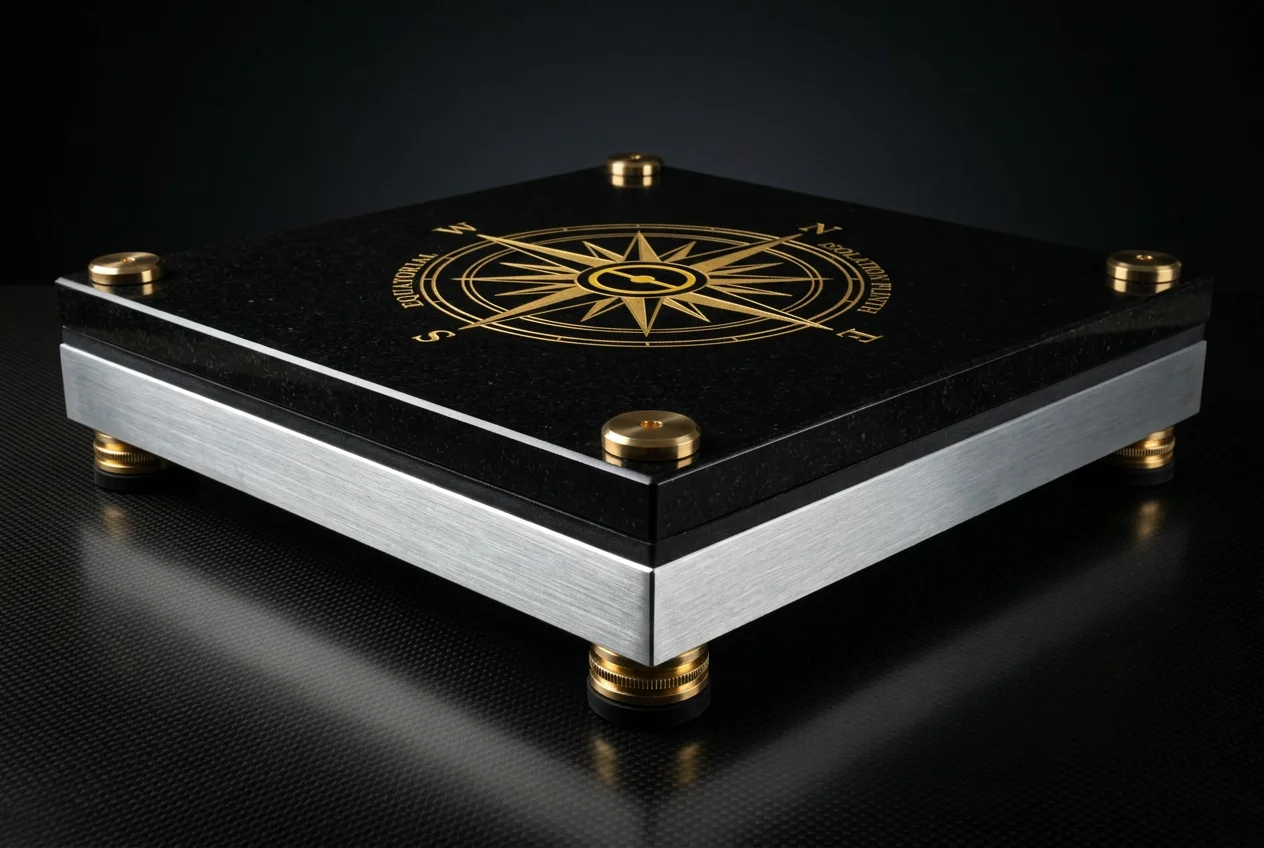
The Equatorial Isolation Plinth is a constrained-layer damping platform comprising three materials selected for their complementary acoustic and magnetic properties. The top layer is equatorial teak — hardwood harvested exclusively from trees grown within 2° of the equator, where the equal duration of day and night cycles throughout the year produces perfectly symmetrical growth rings. Teak grown at higher latitudes exhibits seasonal ring-width variation that creates directional grain asymmetry, which in turn introduces a preferred axis of vibration propagation. Equatorial teak has no such preference. It damps uniformly in all directions. Below the teak sits a layer of lead-loaded MDF, which provides the raw mass necessary to push the assembly's resonant frequency below 3 Hz — well below the audio band and below the lowest frequency produced by any turntable bearing or motor. The foundation layer is a granite slab of verified geological age exceeding 500 million years, predating any significant geomagnetic polarity reversal. Younger stone may carry fossilized magnetic signatures from the Brunhes-Matuyama reversal that could interact with the cartridge's magnetic circuit.
A compass rose is inlaid into the teak surface in brass and contrasting wood. This is not ornamental. During initial setup, the plinth must be oriented so that the compass rose aligns with magnetic north. This ensures that the turntable's mechanical axis is referenced to the same geomagnetic coordinate system as the Equatorial Platter Mat, Record Clamp, and Precision Level. A system in which each component references a different magnetic orientation is a system in which hemispheric biases compound rather than cancel. The compass rose provides a permanent, unambiguous visual reference for correct orientation. Four adjustable feet with integrated bubble levels allow precise leveling independent of the surface beneath.
An internal channel routed through the plinth's cross-section provides a path for the tonearm cable from the rear of the turntable to the output connectors. This channel is lined with mu-metal — a nickel-iron alloy with extremely high magnetic permeability — which shields the tonearm cable from the plinth's own mass-induced gravitational magnetic field. Forty-five kilograms of mixed materials generates a measurable local gravitational distortion, and where there is mass in motion relative to a magnetic field, there is electromagnetic interference. The mu-metal conduit reduces this interference by approximately 40 dB, ensuring that the signal reaching your phono stage reflects only what the stylus extracted from the groove and nothing contributed by the furniture beneath it.