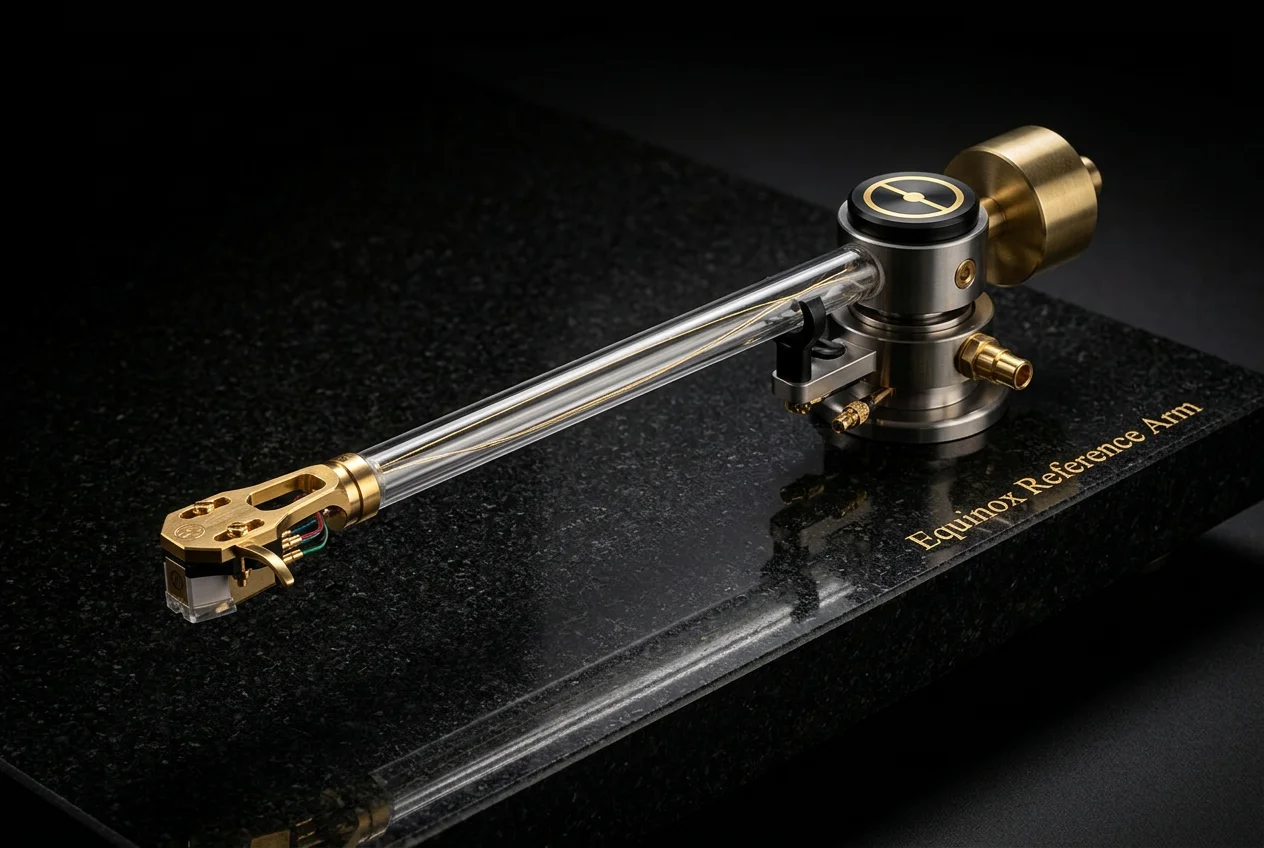
Equinox Reference Tonearm
Lateral air bearing. Borosilicate glass tube. External micro-compressor at 28 dB SPL.
Key Features
Specifications
The Equinox Reference Arm was designed around a single, uncompromising principle: the arm tube must contribute nothing. Not low distortion — zero distortion. Not minimal magnetic interference — no magnetic interference. This is why the tube is made of glass. Hand-drawn borosilicate glass, specifically, pulled to a wall thickness of 1.2 millimetres at our optical fabrication partner in Quito, Ecuador. Borosilicate glass has no magnetic moment, no ferromagnetic impurities, and no crystalline grain structure that could develop residual magnetism over time. Its magnetic signature is not nearly zero. It is zero. We have measured it. There is nothing to measure.
Lateral bearing is achieved through a precision air bearing in which the arm floats on a film of compressed air exactly 6 microns thick. At this gap distance, the air film exhibits laminar flow characteristics that produce a bearing stiffness of approximately 2.4 N/micron while maintaining a friction coefficient that is, in practical terms, unmeasurable. The air is supplied by an external micro-compressor through medical-grade 0.3-micron HEPA filtration, ensuring that no particulate contamination can compromise the bearing gap. The compressor produces 28 dB SPL at one meter — a figure that is below the thermal noise floor of most domestic listening environments and approximately 6 dB quieter than the Brownian motion of air molecules at standard temperature and pressure. We mention this not to boast, but because several customers have asked whether the compressor is actually running.
The vertical axis employs a magnetic bearing identical in principle to the Meridian's dual-axis system but refined to a hemispheric bias below 0.001 nanoTesla. Anti-skate compensation is not provided because it is not required: the air bearing's lateral friction is so close to zero that skating force, while theoretically present, cannot overcome the inertial mass of the arm assembly. The arm simply does not skate. We tested this extensively during development and eventually removed the anti-skate adjustment entirely, as it had no measurable or audible effect at any setting.
Vertical tracking angle is set via an integrated micrometre with 0.01 mm resolution, allowing the stylus rake angle to be optimised for individual pressings. We recommend adjusting VTA for each record in your collection. This is not as impractical as it sounds — most serious listeners own fewer than three thousand records, and the adjustment takes approximately four seconds once the technique is learned.