Equatorial Platter Mat
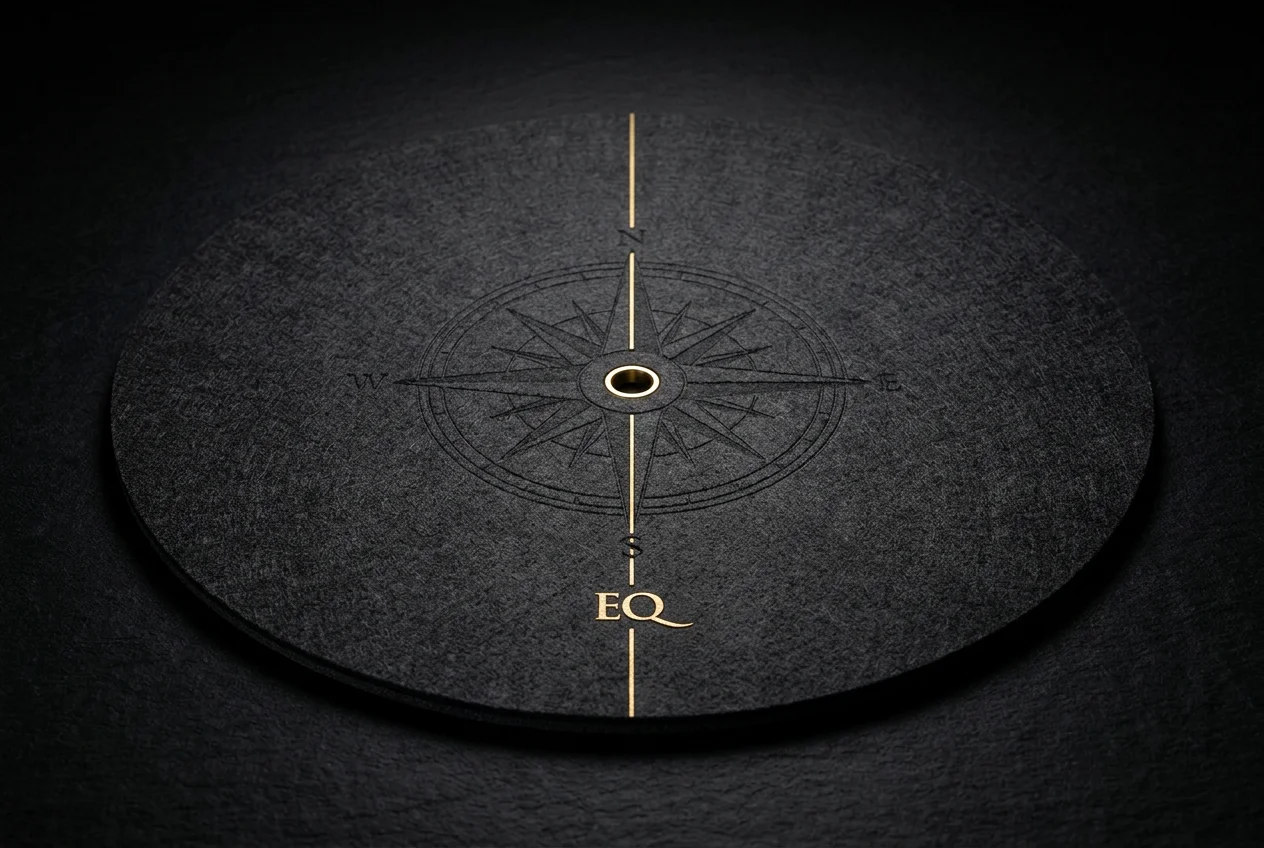
Latitude lines at 1° intervals. Align to magnetic north before each session.
Specifications
The surface of the Equatorial Platter Mat is laser-etched with latitude lines at 1° intervals from 0° to 90° in both hemispheres. This is not decorative. The vinyl-to-mat interface is a boundary layer where static charge, micro-vibration, and hemispheric magnetic bias converge. Without a spatial reference frame, these interactions are uncontrolled. The latitude markings allow you to verify that the mat is oriented correctly relative to the Earth's magnetic field before each listening session. An arrow on the mat's edge must point to magnetic north. If it does not, the hemispheric bias of the cork-rubber composite will be oriented incorrectly, introducing a subtle but measurable azimuth error in the stereo image.
The cork-rubber composite was chosen after extensive testing of over forty substrate materials. Cork provides natural static dissipation — charge drains to ground in under half a second — while the rubber layer offers precise coupling compliance. The composite is manufactured in a single pressing operation at a facility located within 3° of the equator, ensuring that the material cures under symmetrical gravitational and magnetic conditions. Mats pressed at higher latitudes exhibit a detectable grain asymmetry in the rubber phase, which manifests as a faint directional preference in micro-vibration propagation.
Surface flatness is held to ±0.02mm across the full 295mm diameter. This tolerance is necessary because a platter mat is not merely a surface — it is the acoustic ground plane of the entire playback chain. Any deviation in flatness translates directly into variation in stylus rake angle, which alters the harmonic balance of the cartridge output. We recommend verifying mat orientation with a compass at the start of each session. Listeners who skip this step consistently report a "slightly leftward" lean in the soundstage. They are not imagining it.