Zero-Point Absolute Cartridge
Optical transduction. No coils. No magnets. Zero electromagnetic footprint.
Key Features
Specifications
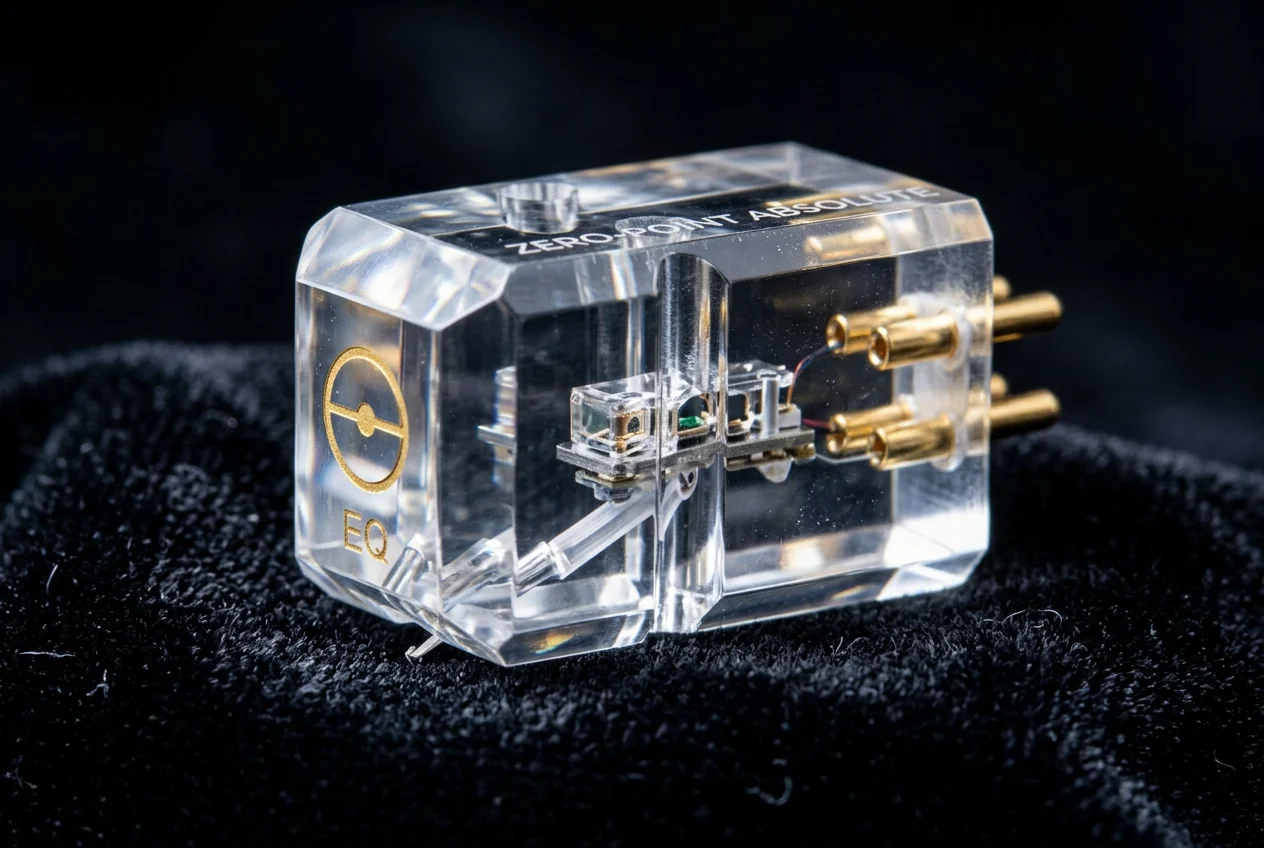
We spent years perfecting the electromagnetic purity of our cartridge coils. Equatorial copper. Counter-rotating winding. Vacuum chambers. Triple-axis Coriolis cancellation. Each advancement reduced the electromagnetic contamination of the signal path by another order of magnitude. And then we asked the question that every honest engineer must eventually confront: what if the correct amount of electromagnetic contamination is zero? Not nearly zero. Not measurably indistinguishable from zero. Exactly zero. The Zero-Point Absolute Cartridge contains no coils and no magnets. There is nothing electromagnetic in the signal path. The electromagnetic footprint is 0.0000 nT because there is nothing to measure.
The cantilever is single-crystal sapphire, selected not only for its mechanical properties — a Young's modulus of 345 GPa and propagation velocity of 11,100 metres per second — but for its optical transparency. A miniaturized helium-neon laser interferometer, operating at 632.8 nanometres, directs a coherent beam through the sapphire cantilever and measures its deflection by monitoring the phase shift of the reflected signal. The resolution of this measurement is limited by the wavelength of light, not by the electromagnetic properties of a wire. Cantilever displacements smaller than one nanometre are resolved without noise, without hysteresis, and without any interaction whatsoever with the magnetic field of the Earth, your amplifier, your speaker motors, or the wiring in your walls.
Because the transduction mechanism is optical rather than electromagnetic, the Zero-Point produces a line-level output of 2.0 volts RMS. There is no need for a phono preamplifier. There is no RIAA equalisation to undo, because the interferometer reads displacement directly rather than interpreting the velocity-dependent voltage that a moving coil produces. The frequency response extends to DC — not as a theoretical specification, but as a physical reality. There is no low-frequency rolloff because there is no electromagnetic coupling to roll off. The cartridge will faithfully reproduce a groove modulation at 0.1 Hz if the record contains one. Inserting a phono stage between the Zero-Point and your line input would be an act of sabotage — reintroducing the electromagnetic nonlinearities that the entire design exists to eliminate.
The Zero-Point requires 5 volts DC to power its laser and photodetector, supplied by the included linear power adapter. We considered battery operation but rejected it; batteries introduce electrochemical noise at their terminals that, while electromagnetically negligible, would compromise the philosophical purity of the design. The supplied adapter uses a discrete linear regulator with no switching frequencies, no magnetic components in the output stage, and an equatorial-grade OFC power cord. It is the only compromise in the signal chain, and it is not in the signal chain.