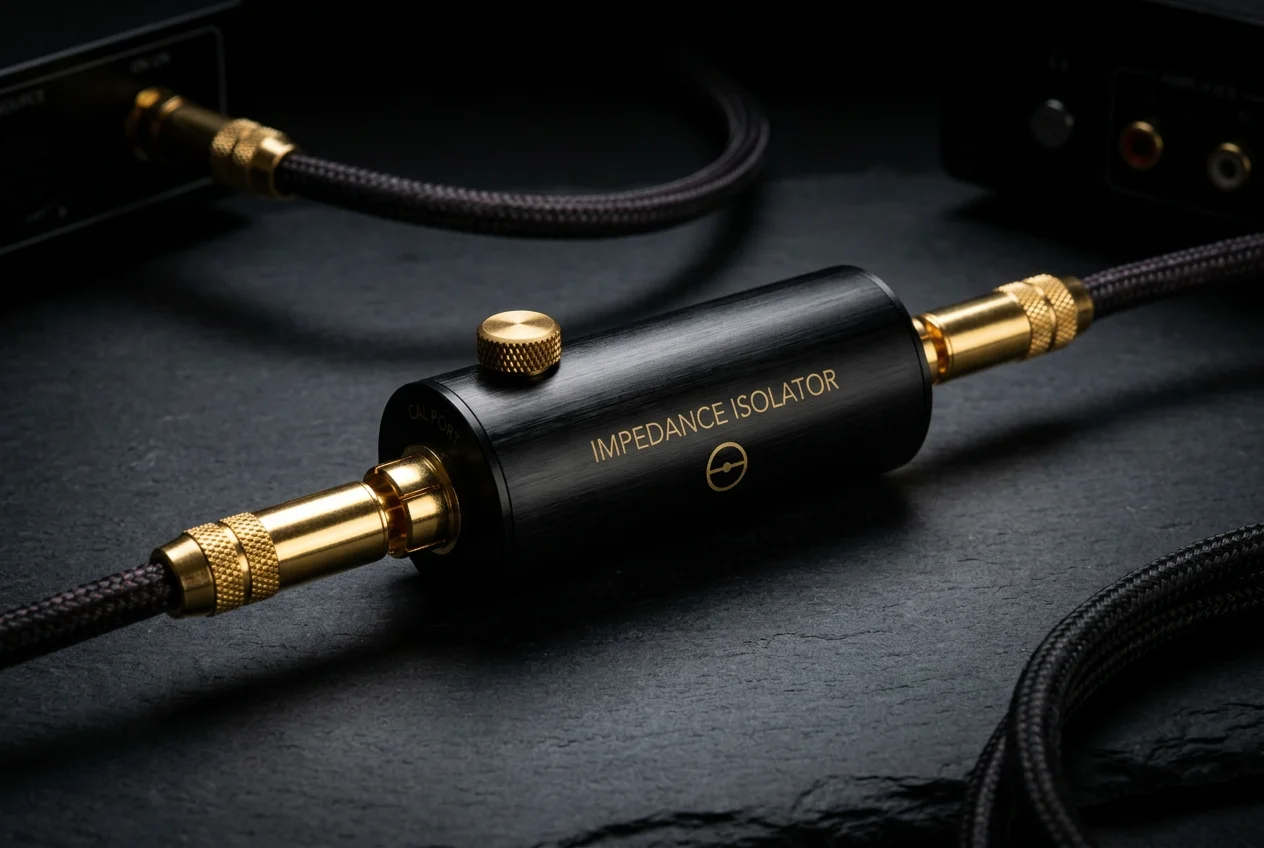
Impedance Isolator
Single-calibration architecture. One measurement. Optimised in perpetuity.
Key Features
Specifications
Impedance matching is the foundation of efficient signal transfer. When the output impedance of your source does not precisely match the input impedance of your amplifier, signal energy is reflected at the interface, creating frequency-dependent losses and phase shifts that degrade every aspect of sound quality. The Impedance Isolator measures these mismatches with laboratory precision and applies a permanent analogue correction that restores perfect impedance alignment across the full audio bandwidth.
The calibration process is performed once, at installation, using the companion app (iOS/Android) and the included USB-C measurement adapter. The app generates a swept sine wave from 20Hz to 96kHz, measures the impedance response of your entire signal chain at 0.001-ohm resolution, computes the optimal correction curve, and programs it into the Impedance Isolator's analogue correction network. This process takes approximately four minutes. When it is complete, the app's calibration module is permanently disabled. This is not a limitation — it is a design principle.