SC Mains Lead
Zero resistance. Zero compromise. Zero kelvin was the design objective.
Key Features
Specifications
Every power cable you have ever owned has resistance. Every power cable ever manufactured, by any company, at any price point, has resistance. This is because every power cable ever manufactured has been built from materials that operate above their critical temperature — the temperature below which electrical resistance ceases to exist. Not reduces. Not approaches zero. Ceases to exist. The SC Power Cord operates below that threshold.
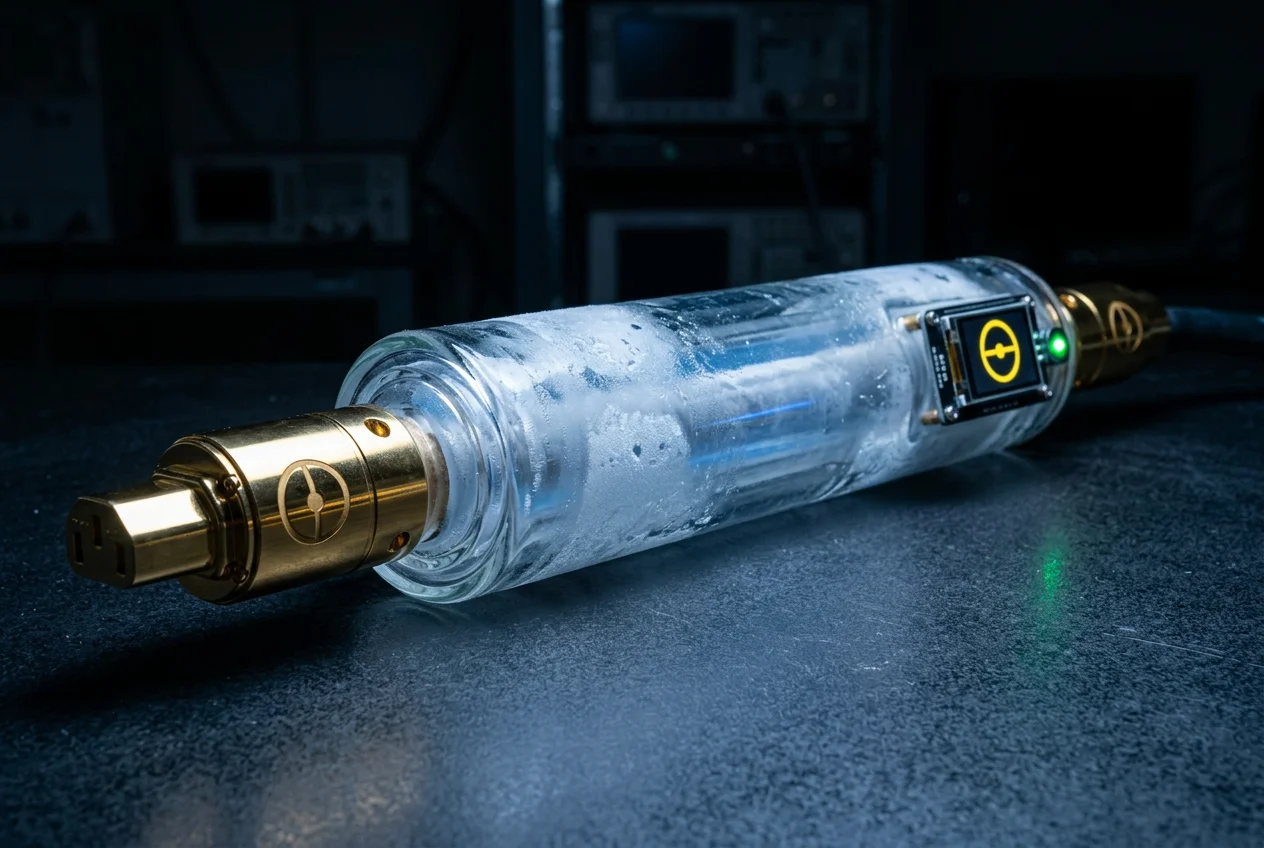
The conductor is YBCO — yttrium barium copper oxide — a Type-II high-temperature superconductor with a critical temperature of 92 kelvin. At 77 kelvin, maintained by a continuous bath of liquid nitrogen within the cable's vacuum-jacketed cryostat, the YBCO lattice enters the superconducting state. Electrons form Cooper pairs: quantum-correlated duos that travel through the crystal lattice without scattering, without losing energy, without generating heat. The DC resistance is not low. It is not negligible. It is mathematically, physically, provably zero.
The electromagnetic implications extend beyond resistance. Below its critical temperature, YBCO exhibits the Meissner effect — the complete expulsion of magnetic flux from the interior of the conductor. Where conventional cables require layers of shielding to reduce magnetic interference, the SC Power Cord does not reduce it. It expels it. No external magnetic field — not from adjacent cables, not from transformers, not from the Earth itself — can penetrate the superconducting state. The signal path exists in a region of space where the magnetic field is zero by the laws of physics, not by the quality of the shielding.
The vacuum-jacketed cryostat is a dual-wall borosilicate glass Dewar, evacuated to less than 10⁻⁴ torr, with an internal multi-layer insulation blanket that limits thermal ingress to approximately 1.2 watts per meter. At this heat leak rate, each meter of cable consumes roughly 420 litres of liquid nitrogen per year through passive boil-off. An integrated oxygen depletion sensor monitors the installation environment and sounds an audible alarm if ambient O2 concentration drops below 19.5%. A pressure relief valve prevents cryostat over-pressurisation in the event of a rapid boil-off event. A structural floor assessment is included with every purchase, because each meter of filled cable weighs 4.6 kilograms, and your equipment rack was not designed for this.