SC Interconnect
The analogue signal path, perfected. Cooper pairs carry your music.
Key Features
Specifications
An analogue interconnect cable has one job: to transport a continuous electrical signal from one component to another without altering it. Every cable alters it. Resistance attenuates the signal in a frequency-dependent manner. Capacitance rolls off the high frequencies. Inductance introduces phase shift. Thermal noise — Johnson-Nyquist noise, generated by the random motion of electrons in any resistive conductor — adds a noise floor that is proportional to resistance and temperature. These are not design flaws. They are physical properties of every conductor that operates above absolute zero and has non-zero resistance. The SC Interconnect has zero resistance and operates at 77 kelvin. It does not merely reduce these effects. It eliminates the physical conditions that cause them.
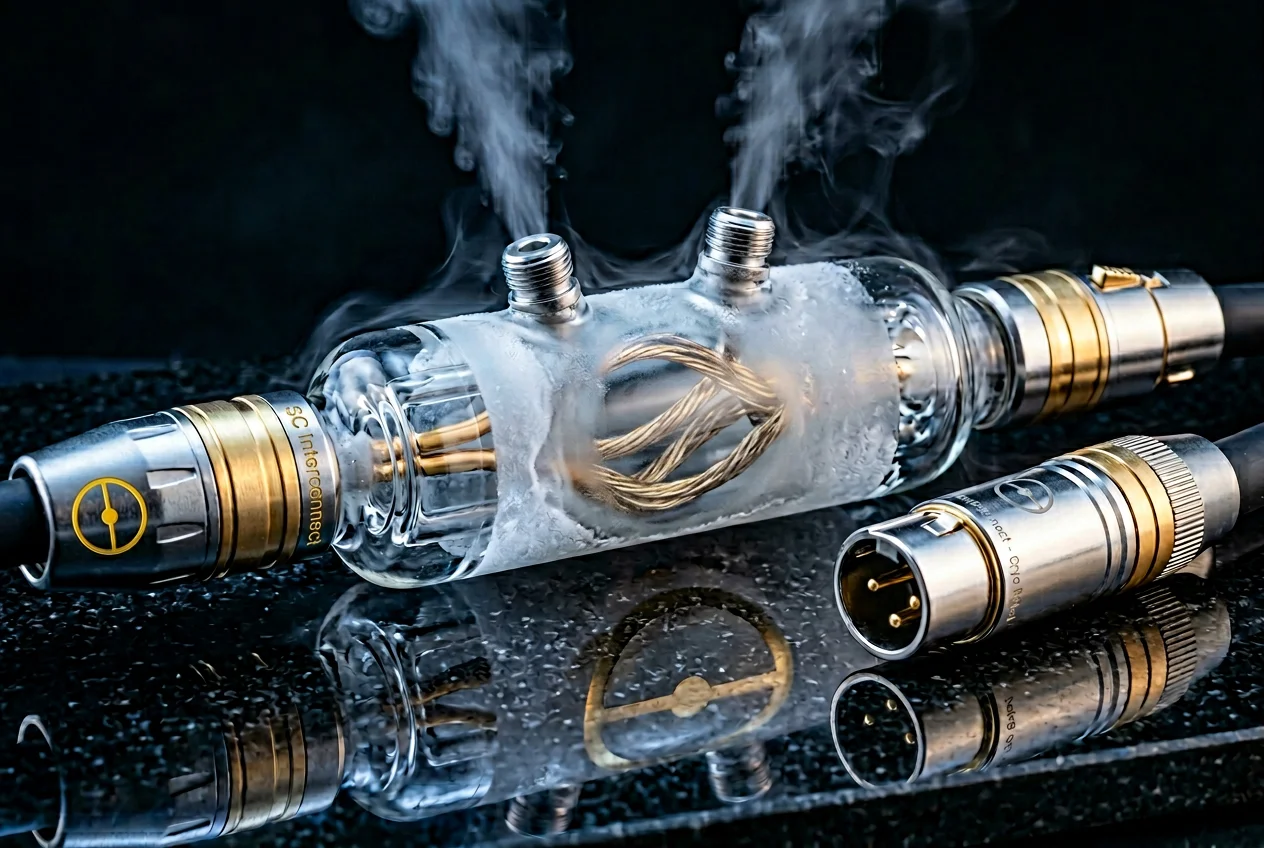
The dual-channel YBCO conductor carries left and right signals through separate bores of a dual-wall vacuum-jacketed cryostat. Each channel is an independent superconductor, each exhibiting the Meissner effect independently. Magnetic flux is expelled from each channel individually, meaning that not only is external magnetic interference excluded, but crosstalk between channels — which in conventional cables is mediated by magnetic coupling — is physically impossible. The measured channel separation exceeds 150 decibels across the full audio band. The frequency response is flat from DC to 2 megahertz with zero measurable deviation. There is no roll-off because there is no capacitive loss. There is no phase shift because there is no inductive reactance at audio frequencies in a zero-resistance conductor. There is no thermal noise because the Johnson-Nyquist noise power is proportional to resistance multiplied by temperature, and the resistance term is zero.
The signal-to-noise ratio of a zero-resistance conductor at any temperature is theoretically infinite. We report it as such because it is not a marketing claim — it is a mathematical consequence of the Fluctuation-Dissipation Theorem applied to a system with zero dissipation. In practice, the noise floor of your system will be determined by your source components and your amplification chain, not by this cable. The SC Interconnect is the first analogue interconnect in the history of audio that can make that statement as a matter of physics, not aspiration.