SC Word Clock Cable
When femtosecond jitter was still too much jitter.
Key Features
Specifications
Word clock distribution is the single most jitter-sensitive application in a digital audio system. The clock signal — a square wave that synchronises every digital-to-analogue conversion, every sample capture, every data transfer — must arrive at each device with edge transitions that are as close to instantaneous as the laws of physics permit. Any delay variation in that edge, measured in picoseconds or femtoseconds, translates directly into timing uncertainty in the conversion process. Every cable in the clock distribution chain introduces jitter. Every cable, that is, that has resistance.
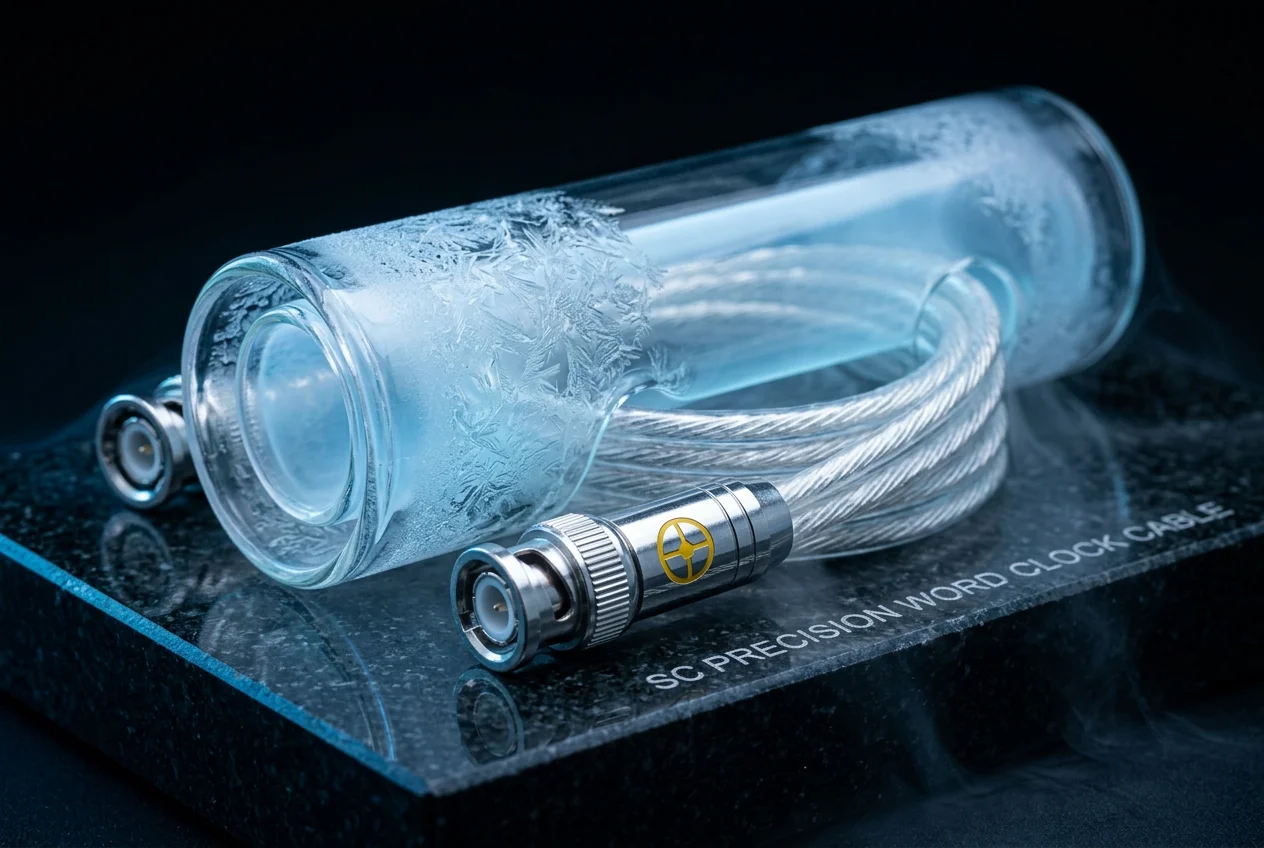
The SC Word Clock Cable has no resistance. The YBCO superconductor, held at 77 kelvin within a vacuum-jacketed cryostat, carries clock signals as Cooper pairs — quantum-correlated electron duos that propagate through the crystal lattice without scattering. There is no resistive loss, and therefore no resistive jitter. The impedance of the cable is locked at exactly 75 ohms by the geometry of the conductor and the dielectric constant of the cryogenic environment, both of which are fixed at 77 kelvin with a stability that room-temperature materials cannot approach. Impedance drift — the slow change in cable impedance caused by thermal expansion, dielectric relaxation, and humidity absorption — does not exist at 77K. The temperature is maintained by liquid nitrogen, which boils at 77.36 kelvin at sea level. It is a thermodynamic constant. The impedance is therefore a thermodynamic constant.
The Meissner effect eliminates the remaining category of clock signal degradation: magnetic interference. Below its critical temperature, the YBCO conductor expels all magnetic flux from its interior. A clock edge traveling through the SC Word Clock Cable exists in a magnetically null environment — not approximately null, not shielded to some number of decibels, but null. No external magnetic field can couple into the clock signal because no external magnetic field can exist where the signal travels. The measured jitter contribution of the SC Word Clock Cable is less than 0.01 picoseconds. This figure represents the noise floor of the test instrumentation, not a property of the cable. The actual jitter contribution of a superconductor with zero resistance and zero magnetic field penetration is, by the relevant physics, zero.