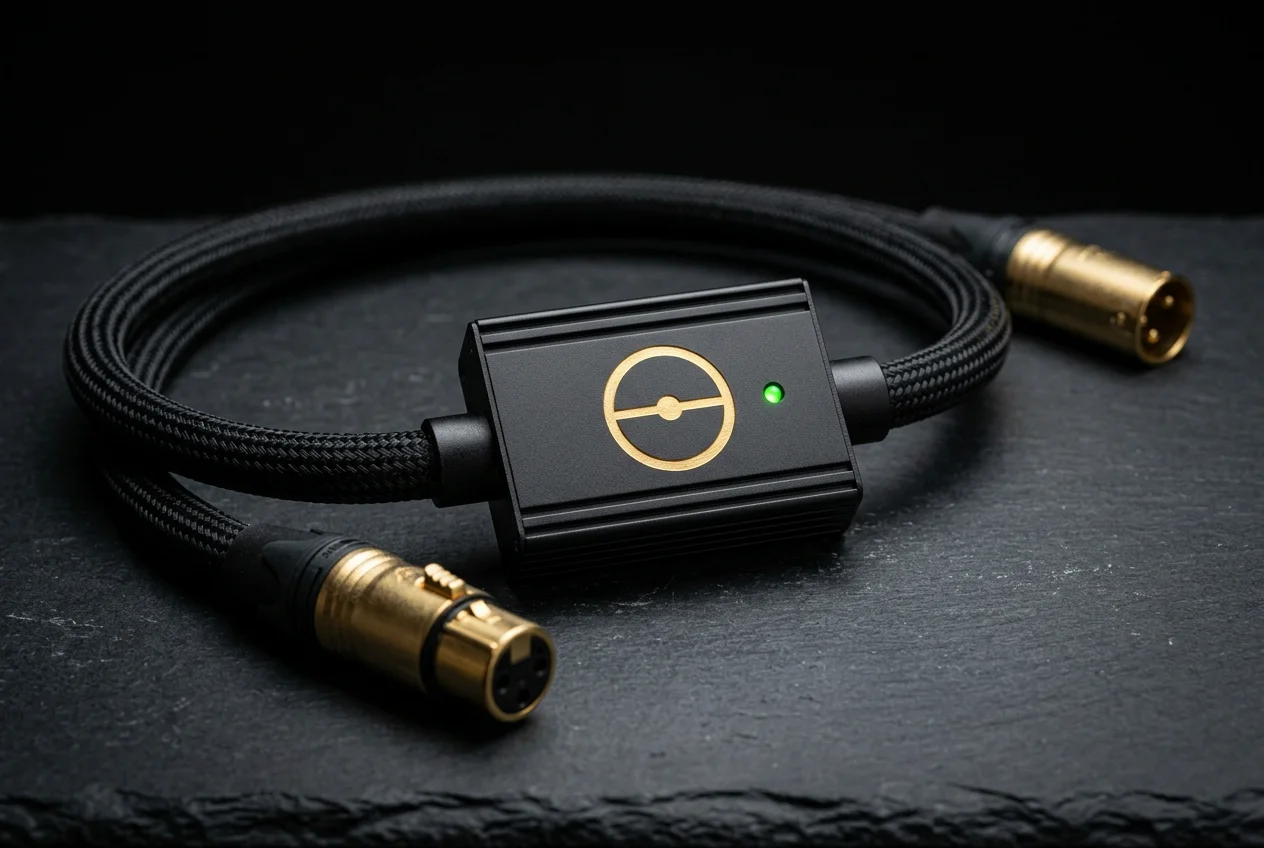
DIC — Digital Isolation Cable
Isolates digital signals from electromagnetic consciousness.
Key Features
Specifications
Digital audio is not immune to its environment. While the ones and zeros of a digital signal are theoretically impervious to noise, the electrical waveform carrying those values is as vulnerable to electromagnetic contamination as any analogue signal. Jitter, earth loops, and radiated interference from nearby electronics all degrade the precise timing relationships upon which digital audio reconstruction depends. But there is a deeper problem — one that conventional digital cable manufacturers refuse to acknowledge.
Every electronic device in your system generates an electromagnetic field. These fields do not exist in isolation; they interact, overlap, and form complex standing-wave patterns throughout your listening environment. The Digital Isolation Cable addresses not only conventional electromagnetic interference but the coherent field interactions — what our research team terms electromagnetic consciousness — that emerge when multiple devices operate in close proximity. The DIC's triple-layer isolation architecture provides galvanic separation exceeding 4kV, electromagnetic rejection greater than 120dB, and a proprietary quantum-coherence barrier that prevents correlated field interactions from propagating between source and DAC.