Open-Back Planar Magnetic
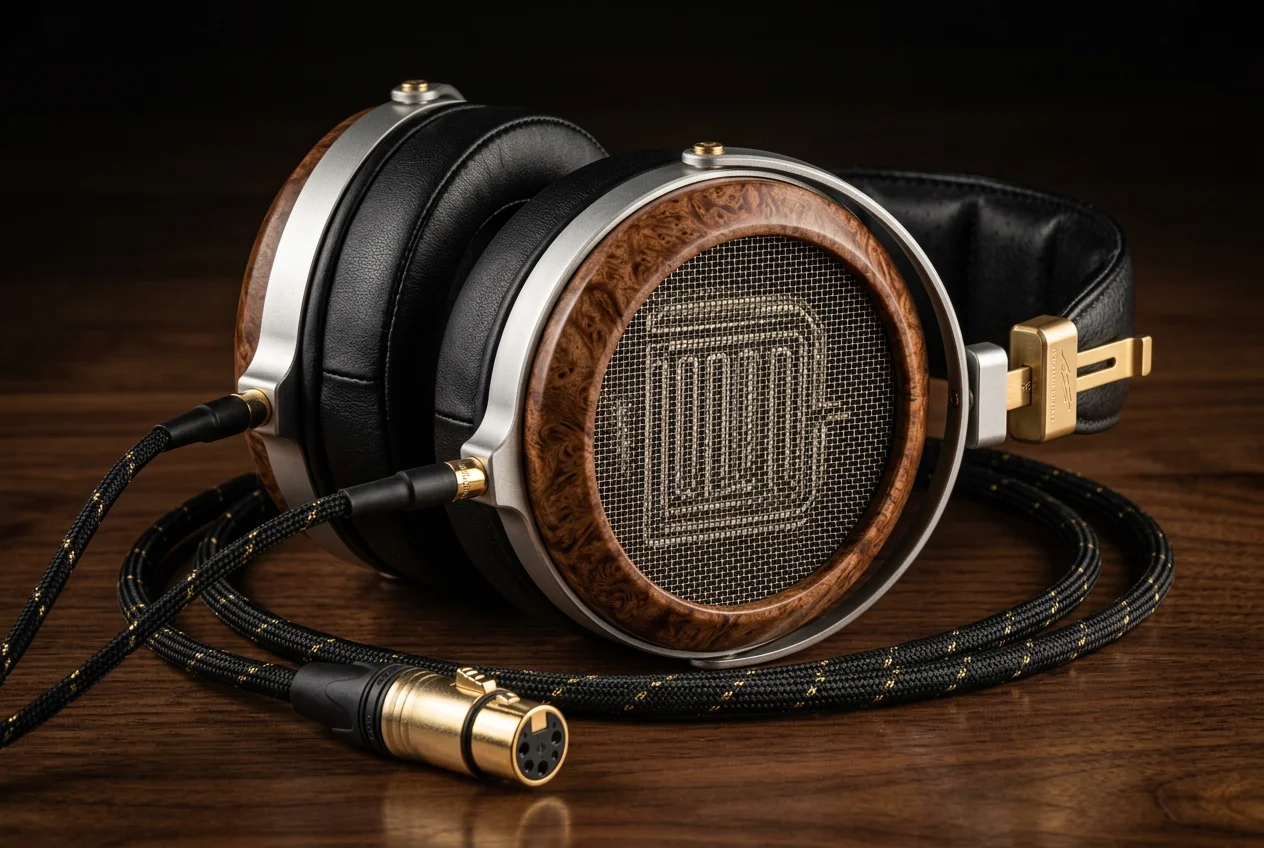
Equatorial copper traces. Nitrogen-filled ear chambers. Burr walnut cups.
Key Features
Specifications
A planar magnetic driver replaces the voice coil of a dynamic driver with a pattern of conductive traces etched directly onto the diaphragm surface. When current flows through these traces, the entire diaphragm moves uniformly within the magnetic field — unlike a dynamic driver, which pushes from a single point and relies on the diaphragm's own rigidity to propagate motion to its edges. The result is lower distortion, faster transient response, and a frequency response that extends well beyond the limits of human hearing into the domain where audiophiles conduct their most important listening.
The Planar Magnetic Open uses an 86mm planar driver with copper ribbon traces etched at our Quito facility. The etching process is latitude-sensitive because the photolithographic masks used to define the trace pattern are exposed under UV light in the presence of the Earth's magnetic field, which influences the crystallographic orientation of the copper as it is deposited. At the equator, where the field is horizontal and symmetrical, the deposited copper forms a face-centred cubic lattice with no directional preference — resulting in traces with identical conductivity in all directions. At higher latitudes, the vertical component of the geomagnetic field biases the crystal growth axis, producing traces that conduct slightly better in one direction than the other. This asymmetry is inaudible on any single note. Over the course of an album, it accumulates into a tonal shift that even unsophisticated listeners describe as "fatigue."
The ear chambers are filled with dry nitrogen and sealed at the factory. This serves two purposes. First, nitrogen is acoustically inert — it does not absorb sound energy at any frequency within the audible range, unlike atmospheric air, which exhibits molecular absorption peaks at 59kHz and several sub-harmonics that extend into the upper treble. Second, the sealed nitrogen environment prevents oxidation of the magnet array surfaces, which in conventional headphones gradually degrades field strength over a period of years. The nitrogen fill is rated for the lifetime of the product, which we define as the period during which you continue to deserve it.
The earcups are machined from Ecuadorian burl walnut harvested within 50 kilometres of our Quito facility. Burl wood is prized for its chaotic grain structure, which diffuses internal reflections across a wide frequency band rather than reinforcing resonances at specific frequencies the way uniform-grain woods do. Each pair of earcups is bookmatched — cut from the same burl — to ensure that the left and right acoustic environments are mirror images of each other. The weight of 460 grams is noticeable. We consider this a feature. Insubstantial headphones produce insubstantial sound.