Class A Headphone Amplifier
Hybrid valve desktop amplifier. Equatorial output transformers. Separate L/R power supplies.
Key Features
Specifications
A headphone amplifier has one job: deliver voltage and current to a headphone driver in exact proportion to the input signal. Every deviation from this proportionality is distortion. The Class A Headphone Amplifier minimises these deviations through the most direct means available — a topology in which the output devices are biased to conduct current continuously, never switching off during any part of the signal waveform. In Class B and Class AB amplifiers, the output devices take turns: one handles the positive half of the waveform, the other handles the negative half, and at the transition point between them — the zero crossing — there is a brief interval during which neither device is fully conducting. This interval produces crossover distortion, a form of nonlinearity that adds odd harmonics to the signal at every zero crossing. Class A eliminates this entirely by keeping both devices conducting at all times. The penalty is heat. The amplifier dissipates 65 watts continuously, regardless of signal level, most of it as thermal energy radiated from the chassis. This is the cost of zero crossover distortion. We consider it reasonable.
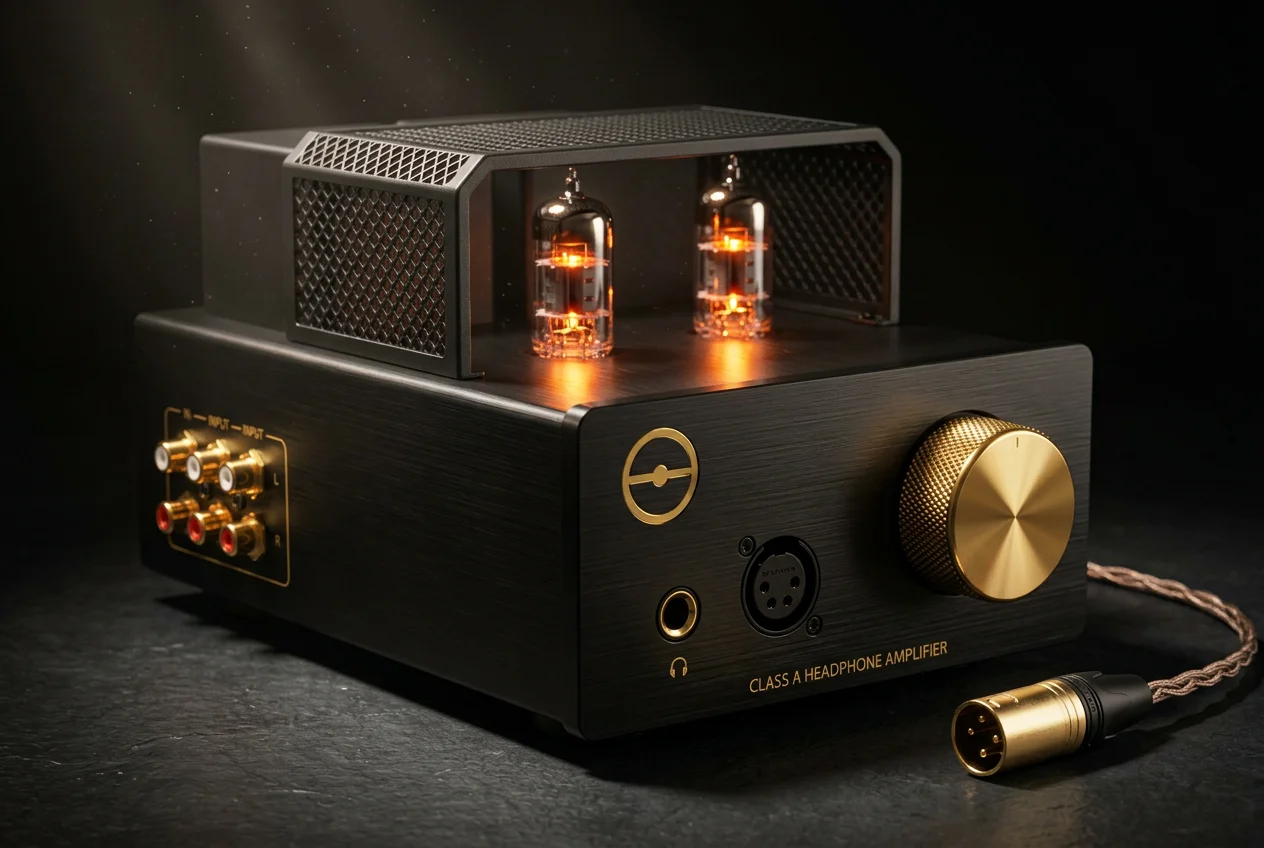
The input stage uses a matched pair of NOS (new old stock) Mullard 12AU7 vacuum tubes — manufactured in Blackburn, England, in the 1960s, before the factory closed and the tooling was destroyed. We maintain a stock of these tubes sufficient for current production; when the stock is exhausted, we will evaluate alternatives. The 12AU7 was selected for its low plate resistance and high linearity, which make it suitable as a voltage amplification stage driving the MOSFET output devices. The tube's contribution to the amplifier's harmonic signature is predominantly second-order — a form of distortion that the human auditory system processes as warmth and presence rather than harshness. We do not claim that tube distortion is desirable. We claim that it is less undesirable than the distortion produced by solid-state input stages operating without global feedback.
The power supply is a dual-mono design with separate transformers for the left and right channels. The transformers are wound at our Quito facility using the same equatorial winding techniques developed for our cable products. A shared power supply creates a coupling path between channels: when one channel draws current during a dynamic peak, the power supply voltage sags momentarily, affecting the other channel's operating conditions and producing intermodulation distortion between the left and right signals. Separate transformers eliminate this coupling. Each channel operates as though the other does not exist.
The chassis is machined from a solid billet of 6061 aluminium with a copper-plated steel liner on the interior surfaces. The copper plating provides electromagnetic shielding that prevents radiated interference from the transformers and rectifier from reaching the signal path. The amplifier provides three headphone outputs — 6.35mm single-ended, 4-pin XLR balanced, and 4.4mm Pentaconn balanced — all driven from the same output stage through precision resistor networks. Only one output should be used at a time. Connecting headphones to multiple outputs simultaneously divides the amplifier's output current among them in a ratio determined by their respective impedances, which is unlikely to produce a satisfactory result for any of them.