Zero-Point GPU
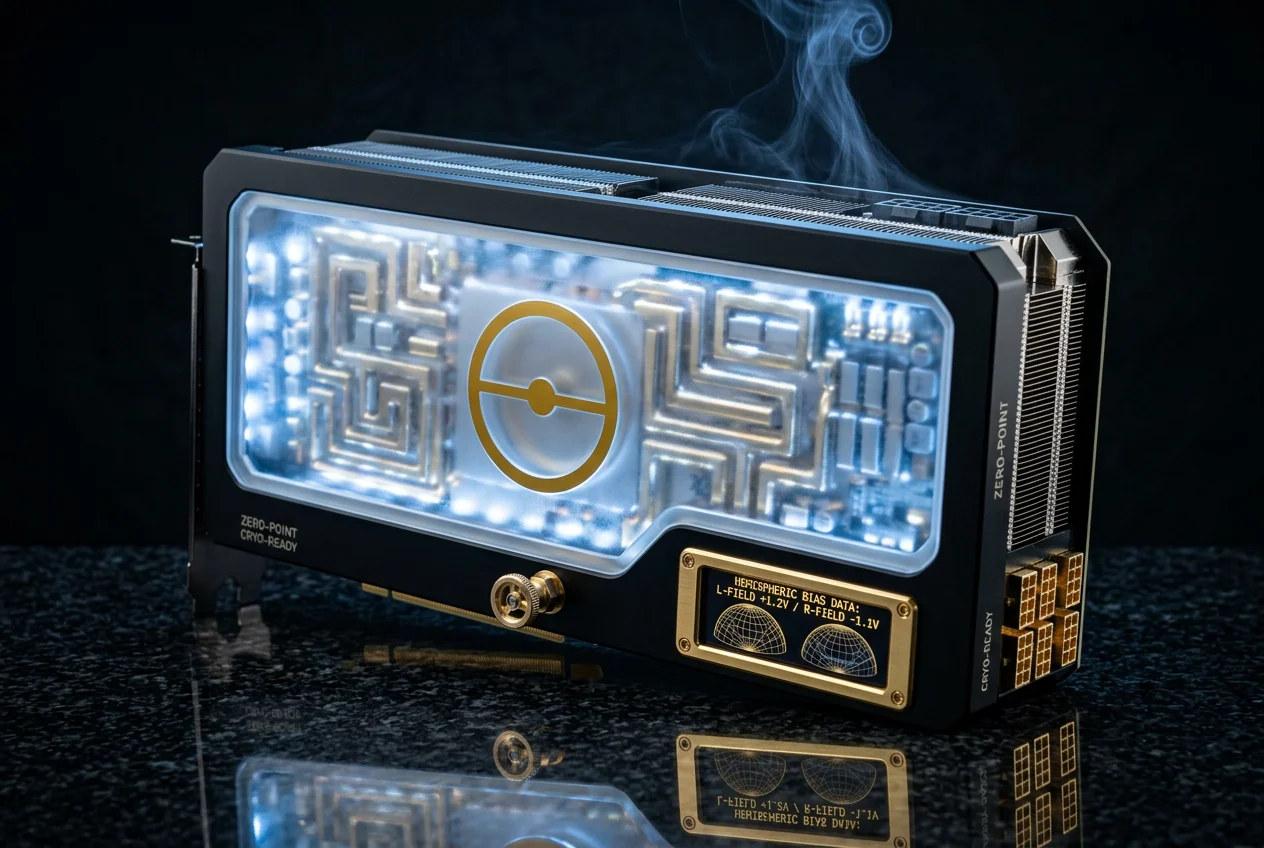
Superconducting VRM. On-board cryostat. Hemispheric bias OLED display.
Key Features
Specifications
The Zero-Point GPU is the culmination of everything we know about computational neutrality. It does not compromise. It does not approximate. It achieves a Hemispheric Inference Bias of < 0.04 nT — a figure so close to the theoretical zero-point of magnetic contamination that we named the tier after it.
The defining innovation is the self-contained cryostat. The Equinox requires external LN2 supply, which introduces logistical complexity and dependency on liquid nitrogen availability. The Zero-Point eliminates this dependency with an integrated Stirling-cycle cryocooler — a closed-cycle refrigeration system that reaches 77K using only electrical power. No consumables. No refills. Plug it in and the cryostat reaches operating temperature in 12 minutes. The cost is 180 watts of continuous electrical power for the cryocooler, bringing total card power to 780 watts. A dedicated 15-amp circuit is recommended.
With the cryostat maintaining 77K across the entire card, the superconducting signal path extends beyond the VRM. The silicon interposer that connects the GPU die to the HBM3e memory stacks is replaced with a YBCO superconducting interposer. The memory bus traces are superconducting. The TSVs (through-silicon vias) within each HBM stack are plated with YBCO. The result is a zero-resistance signal path from the VRM output to the GPU die to the memory and back. Every electron travels without scattering, without resistance, without the thermal noise that resistance creates.
The Meissner effect — the complete expulsion of magnetic flux from a superconductor — is exploited structurally. The GPU die sits on a YBCO platform that, when cooled below 93K, excludes all magnetic flux from its volume. The die levitates 0.3mm above the substrate, suspended by the repulsive force between the superconductor and a permanent magnet array in the substrate. This eliminates mechanical contact between the die and the PCB, removing the last pathway for vibration-induced microphonic noise in the power delivery network.
The 1.3-inch OLED display on the card's top edge provides real-time instrumentation. It shows the ambient Hemispheric Inference Bias in nanotesla, decomposed into three Cartesian axes. It shows the cryostat temperature. It shows the Equatorial Purity Index, recalculated every 100 milliseconds based on the current magnetic environment. For users who find the numbers distressing — particularly those located above 30° latitude — the display can be dimmed or disabled via the EQ-BIAS software.
The on-board 14-billion-parameter AI model deserves acknowledgment. It runs continuously on a dedicated block of tensor cores, consuming approximately 40 watts. Its purpose is to detect and compensate for inference bias in real time by analyzing the output tensor of every compute operation and applying a correction factor derived from the current magnetometer readings. This is not post-processing — it is inline bias compensation at the hardware level. The model was trained on 2.3 petabytes of inference outputs collected at latitudes ranging from 0° to 70°, and it can correct for hemispheric bias up to 12 nT with no measurable impact on throughput. A $30/month subscription is required after the first year to maintain access to model updates that track changes in the Earth's magnetic field as it drifts.