Zero-Point Digital Cable
Neural signal perfection. 387 billion parameters between your source and your DAC.
Key Features
Specifications
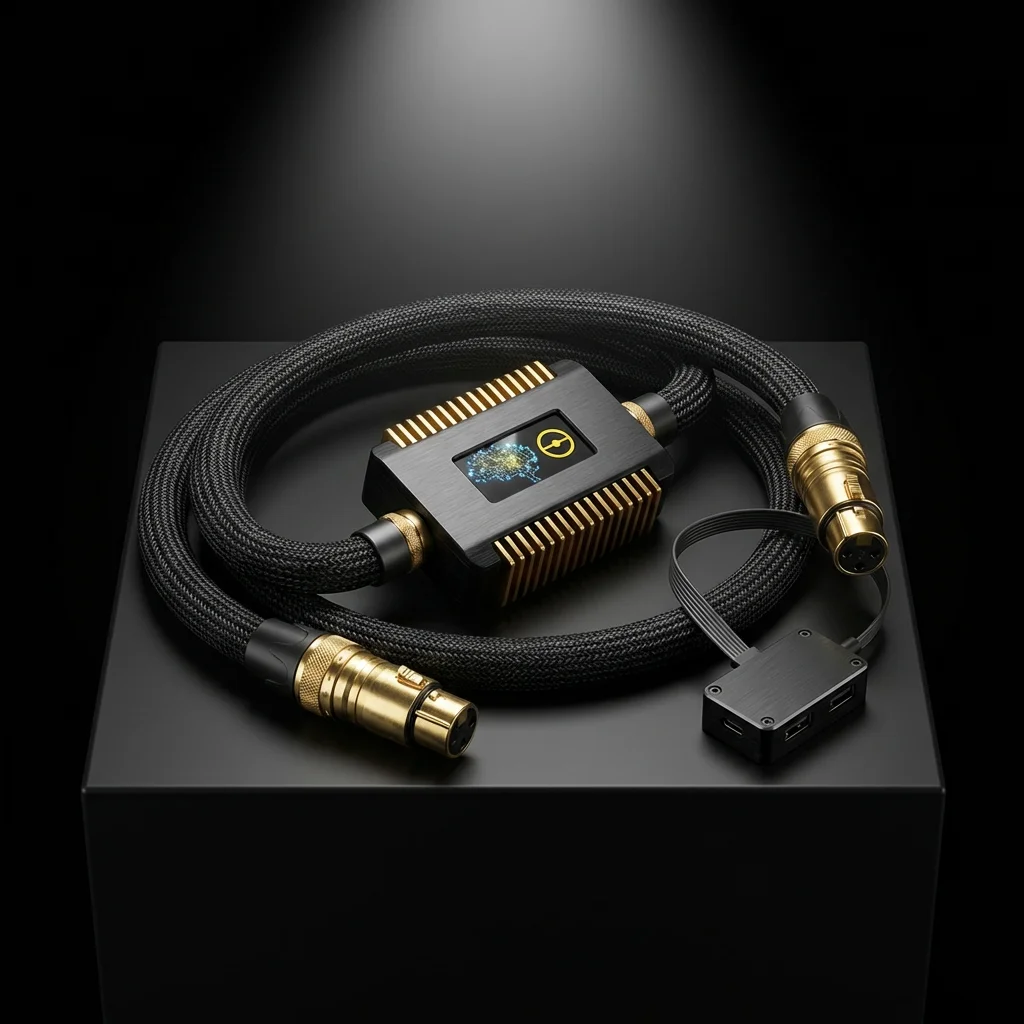
Every digital cable in existence, including the other cables in our own lineup, operates on the same passive principle: the conductor carries the signal, and whatever happens to that signal in transit is a function of the cable's fixed physical properties. The Zero-Point Digital Cable rejects this paradigm entirely. Embedded within each meter of cable are 384 micro-sensors that continuously measure signal timing, pulse-edge geometry, dielectric charge state, and ambient electromagnetic conditions along the entire length of the conductor. This telemetry data is transmitted in real time to a dedicated compute cluster running EquatorialNet v4.2 — our proprietary 387-billion-parameter neural network — which analyzes the data and generates corrective electromagnetic fields applied through a secondary conductor array woven into the cable geometry. The system performs 14,000 corrections per second. Jitter is not merely reduced. It is predicted, intercepted, and neutralised before it reaches your DAC.
The conductor itself is a single-crystal alloy of silver and gold, grown in a controlled electromagnetic environment at our facility in Quito. Silver provides the highest electrical conductivity of any element; gold provides absolute corrosion immunity and a crystalline lattice spacing that, when alloyed with silver in our proprietary ratio, produces a conductor with pulse-edge characteristics that exceed either metal alone. The single-crystal structure eliminates grain boundaries entirely, and the silver/gold alloy eliminates the oxide formation that can develop at the molecular surface of pure silver conductors over time. The passive jitter performance of the conductor alone — less than 0.1 picoseconds — would be reference-class in any other cable. With the AI correction system engaged, measured jitter drops below 0.001 picoseconds, a figure that exceeds the measurement capability of all commercially available audio analyzers.
The five NVIDIA DGX H200 racks required by the system represent a significant infrastructure commitment. Each rack contains eight H200 GPUs operating at a combined 32 petaflops of inference throughput, and the full cluster draws 23.8 kilowatts under load. A dedicated 5-ton HVAC system is required for the compute room, which should be located no closer than eight meters from the listening environment to prevent acoustic contamination from cooling fans. These are not obstacles. They are the requirements of a system that has moved beyond the physical limitations of passive signal transmission into a domain where the cable actively understands, anticipates, and perfects the signal it carries.
Installation is performed by our certified AI Cable Integration team over a three-day period. The first day covers physical cable routing, sensor calibration, and GPU cluster commissioning. The second and third days are devoted to a 72-hour neural network fine-tuning session in which EquatorialNet analyzes your specific source components, DAC, room acoustics, and listening preferences to build a custom inference model optimised for your system. Once calibrated, the system learns continuously — adapting to changes in equipment, room conditions, and your evolving musical tastes. Annual recalibration is included for the first three years. After that, the system will likely know your preferences better than you do.