Tropic Digital Cable
One's ones and zeroes deserve equatorial precision as well.
Key Features
Specifications
There is a persistent myth in the audiophile community that digital cables do not matter — that because the signal is a stream of ones and zeros, the physical medium carrying those values is irrelevant. This is a comforting belief, and it is wrong. A digital audio signal is not an abstraction. It is a series of voltage transitions occurring at precise intervals, and those transitions are subject to the same electromagnetic laws that govern every other electrical signal. When the conductor carrying those transitions has been drawn from hemispherically biased copper, the resulting asymmetry in the magnetic field surrounding the conductor introduces timing errors — jitter — that no amount of error correction can fully remove.
The Tropic Digital Cable addresses this at the most fundamental level available at its price point. The conductor is drawn from Equatorial-Grade OFC mined within five degrees of the geographic equator, achieving a hemispheric bias of less than 0.01 nanotesla. The PE foam dielectric provides stable impedance characteristics across the full signal bandwidth, ensuring that the 75-ohm characteristic impedance remains within half a percent of nominal from the lowest clock frequency to 192kHz sampling rates. At a measured jitter of less than 12 picoseconds, the Tropic outperforms digital cables costing twice as much that have never been evaluated for hemispheric origin.
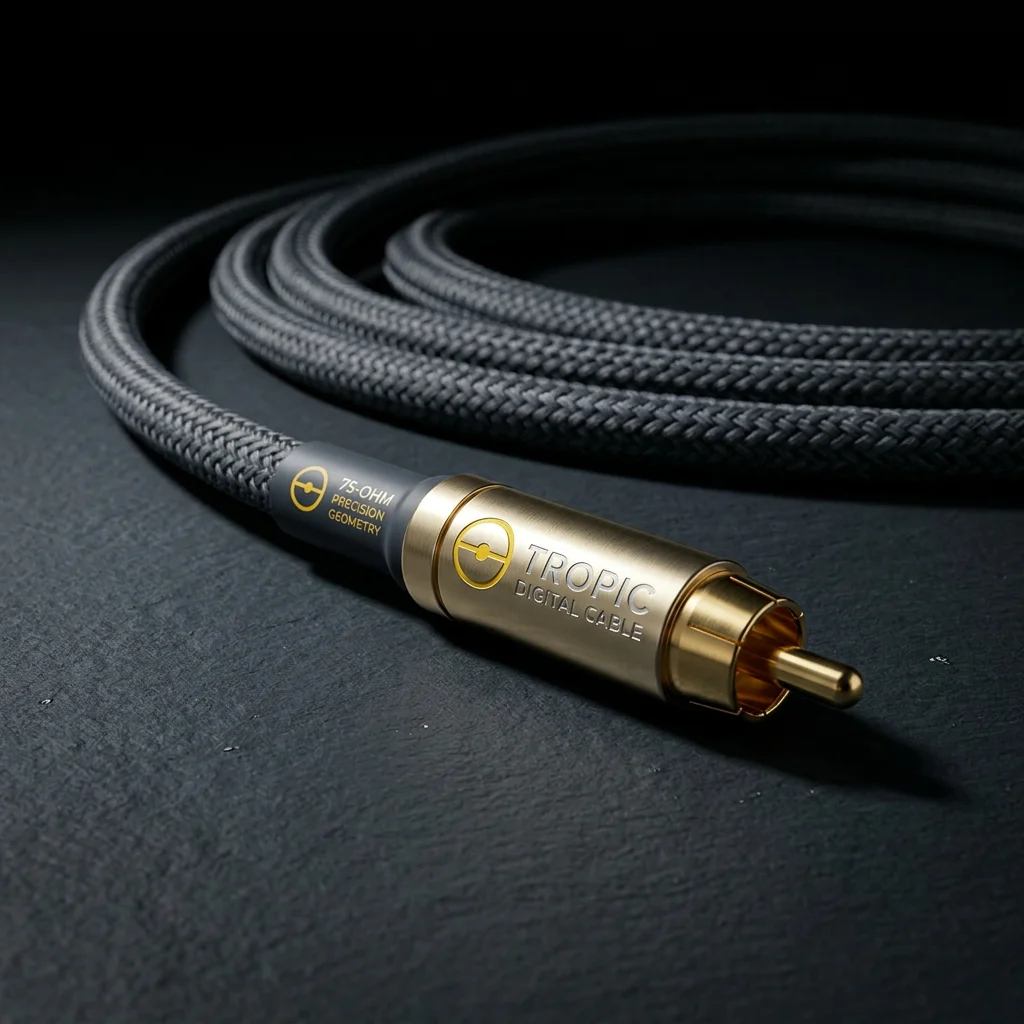
The SPDIF RCA variant employs a true 75-ohm coaxial geometry that maintains impedance continuity through the connector interface, delivering performance that will reveal the hemispheric contamination present in whatever cable it replaces. For listeners requiring an optical TOSLINK connection, the Tropic TOSLINK Cable is available in our Optical range — featuring the same equatorial philosophy with the addition of dual-layer EMI shielding to protect against evanescent field perturbation.