Meridian Word Clock Cable
Sub-picosecond jitter. Rhodium BNC. Mu-metal shielded.
Key Features
Specifications
The word clock signal is a square wave — a series of sharp transitions between voltage states that define the precise instant at which each digital audio sample is captured or reproduced. The sharpness of these transitions determines the temporal resolution of the entire digital audio system. When a clock transition is softened by the impedance characteristics of a mediocre cable, or shifted by the magnetic interference that penetrates insufficient shielding, the receiving device must interpret an ambiguous signal and decide when the transition occurred. This decision introduces uncertainty. Uncertainty is jitter. Jitter is the enemy.
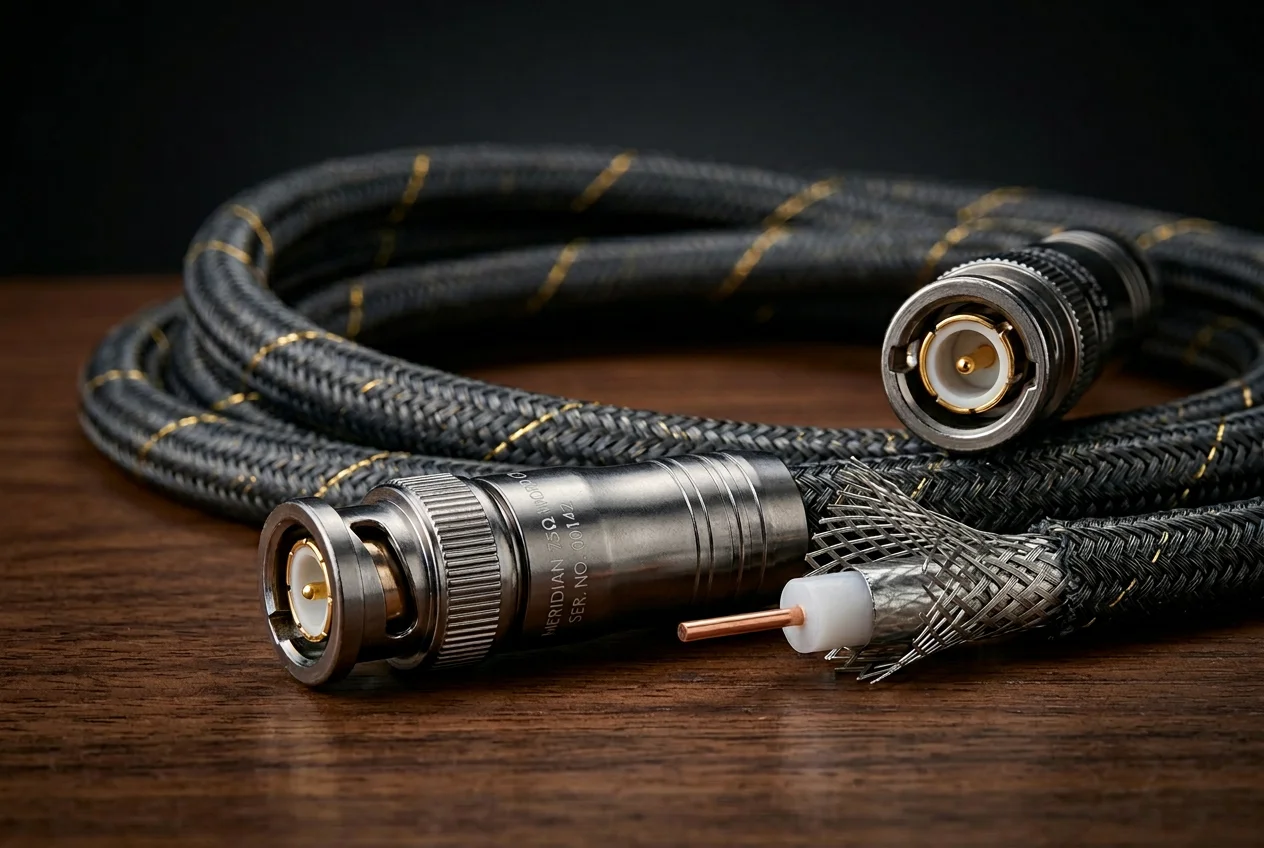
The Meridian Word Clock Cable attacks jitter from three directions simultaneously. The silver-plated OFC conductor provides the lowest possible surface resistance at the frequencies where clock signals operate, preserving the sharp pulse edges that eliminate timing ambiguity at the receiver. The triple-layer shielding — braided copper, foil, and mu-metal — rejects electromagnetic interference across three distinct mechanisms: the braid attenuates radio-frequency interference, the foil blocks electrostatic coupling, and the mu-metal layer absorbs low-frequency magnetic fields that pass through conventional shielding materials as though they were not there. It is the mu-metal layer that distinguishes the Meridian from every other word clock cable on the market. Magnetic interference from power transformers, motors, and the Earth's own field operates at frequencies below the effective range of copper shielding, and it is precisely this interference that causes the slow, insidious clock wander that degrades audio quality without producing any obvious artifact.
The rhodium-plated BNC connectors complete the signal path with a contact interface that is harder, more conductive, and more resistant to oxidation than gold. At the microscopic level where the connector pin meets the socket, rhodium maintains a consistent contact topology that does not degrade over insertion cycles — ensuring that the 75-ohm impedance is preserved through the connector interface where most clock cables introduce their largest impedance discontinuity. The Meridian achieves a jitter contribution of less than 1.2 picoseconds and an Equatorial Purity Index of 99.9997%, delivering sub-picosecond temporal precision to systems that demand it.